← Change place
ITL1
TLJ
OverviewThe Brexit StoryWhat happened since Brexit?Local StoriesRobustness
South East / ITL1 TLJ
ITL1 TLJ

South East

Tracing the local economic footprint of Brexit through production and household income.

South East
GVA gap in 2023
−£64,956m
GVA shows the stronger divergence.
Average GVA gap since 2016
−£28,171m
Persistent negative gap over the post-Brexit era.
GDHI gap in 2023
−£1,120m
GDHI is nominal and may understate real effects.
How to read this place report
  1. Overview — headline output and income gaps and how they evolve.
  2. The Brexit Story — the causal chain from austerity and immigration panic to the Brexit vote and its economic costs.
  3. What happened since Brexit? — trade exposure, immigration, and interpretive context.
  4. Local Stories — mapped reporting and evidence linked to this geography.
  5. Robustness — placebos, donor pools and method notes.

1. Headline outcomes

Metric
Treatment window
Gross Value Added (GVA)
£ million (real chained-volume measure, nominal for GDHI)
GVA · Post-2016
The post-2016 gap is around −£64,956m in 2023 (−17% vs. synthetic path).
GVA gap path
Observed minus synthetic control (£m)
By 2023 the GVA gap is −£64,956m relative to the synthetic path.
Reading the result
  • By 2023, observed GVA is £326.1bn against a best synthetic path of £391.0bn, leaving a shortfall of £65.0bn or -16.6%. This is a real chained-volume output measure, so it is the main reading of local economic divergence.
  • The post-2016 GVA gap is persistent and worsening rather than a one-year dip: it is negative in every year from 2016 to 2023, moving from -£7.0bn in 2016 to -£40.7bn in 2022 and -£65.0bn in 2023. Across the full post-treatment period the cumulative shortfall is about £225.4bn, equivalent to roughly £23,767 per person, with a latest per-person output shortfall of about £6,850.
  • The post-2020 GVA window points in the same direction but is less severe: by 2023 observed GVA is £326.1bn versus a best synthetic £352.1bn, a gap of -£26.0bn or -7.4%. That later-window path is negative in every year from 2020 to 2023, so it strengthens the post-2016 picture rather than overturning it, though with a smaller estimated shortfall.
  • GVA is the cleaner local-output measure here: it is production-side and measured as real chained-volume output, while GDHI is nominal resident income and can include transfers, pensions, capital income, social security, and labour income earned elsewhere. GDHI is still useful context — in 2023 its gap is -£1.1bn versus the GVA gap of -£65.0bn — but the classification remains based on GVA.
South East / ITL1 TLJ

Local stories

Local reporting linked to South East.

South East
Local stories

South East

58 distinct local stories are currently linked to South East. Coverage runs from 2021 to 2026. The dominant storylines revolve around Costs & paperwork, Export barriers, and Labour & staffing, with the most common cited channels being Customs and border administration, Regulatory burden or simplification, and Export demand and market access.

  • 32 of 58 stories describe a negative local effect, most often through Customs and border administration, Regulatory burden or simplification, and Export demand and market access.
  • The most common local story themes are Costs & paperwork (45), Export barriers (35), and Labour & staffing (25).
  • 22 stories cite a concrete figure or reported statistic, including eight to 20 hours and 150,000 bottles shipped.
Mechanisms most cited

58 linked stories

Customs and border administration
18
Regulatory burden or simplification
13
Export demand and market access
6
Digital and data systems
5
Wage and employment channel
4
Global value-chain disruption
3
Investment wait-and-see
3
FDI and location choice
2
Common themes
Costs & paperwork
45
Export barriers
35
Labour & staffing
25
Supply chain pressure
25
Delays & disruption
24
Relocation & investment
22
Sectors most mentioned
Port logistics / food and plant imports
2
Architecture, construction services and professional labour
1
Automotive manufacturing / EU market access
1
Border infrastructure / logistics
1
Border logistics / food and plant imports
1
Brewing / small food and drink exports
1

Stories

The Guardian5 June 2026Music, live performance and creative exports

Brighton and Hove: musicians face lower EU work and tour earnings after Brexit

In Brighton and Hove, music venues, promoters and independent performers are exposed to the same post-Brexit touring barriers described in Guardian reporting on UK musicians. The report found that more than a quarter of UK musicians had lost all EU work since 2021, nearly half had seen EU opportunities reduced, average tour earnings had fallen by 45%, and 59% said European touring was no longer viable. For a city or regional music economy, the mechanism is a loss of exportable live-work opportunities, fewer inbound and outbound tours, weaker collaboration and lower income for small artists and venues that depended on frictionless EU mobility.

The Guardian4 June 2026Steel / heavy manufacturing exports

Southampton: The Guardian reported that planned EU steel quota reductions could almost halve

In Southampton and Solent manufacturers, the source evidence points to a Brexit-linked physical-goods trade channel. The Guardian reported that planned EU steel quota reductions could almost halve tariff-free access for British steel, with industry warning of damaging effects on exports. For a steel-using or steel-producing industrial region, the risk is that EU market access becomes rationed by quota administration, raising uncertainty for order books, processing capacity and integrated supply chains.

The Guardian1 June 2026Creative industries / performing arts exports

Oxfordshire CC: Creative industries / performing arts exports Brexit exposure

Oxfordshire CC has creative-industry, theatre, film, music, performance or events exposure. Guardian reporting described post-Brexit restrictions that curtailed UK actors’ EU work, with performing-arts exports to the EU falling from £1.1bn in 2016 to £929m in 2023. For creative workers and firms in Oxfordshire CC, the channel is labour mobility and service exports: visas, social-security rules, customs documents and tax treatment reduce the pool of accessible jobs and raise the fixed cost of touring, casting and cross-border production.

The Guardian31 May 2026Regional productivity, investment and labour-market performance

Oxfordshire CC: Brexit linked to weaker GDP, investment, employment and productivity

In Oxfordshire CC, the regional-prior layer treats productivity as a key route from Brexit exposure to living standards. Guardian reporting summarised research suggesting that UK GDP per head, investment, employment and productivity are lower than under a remain scenario, with business investment frozen by uncertainty and trade frictions. For local economies, this source family is best used as macro context: it helps interpret why regions with high trade exposure, high-value services or capital-intensive industries may show weaker output per worker after Brexit.

The Guardian28 May 2026Food exports / SMEs

Portsmouth-area food exporters set to benefit from removal of SPS paperwork

In Portsmouth and the South Coast food-export economy, the planned UK-EU SPS agreement would reduce the paperwork burden that had made EU sales costly for smaller producers. Guardian reporting said the deal would remove paperwork and physical checks for dairy, fish, cheese, eggs and fresh red meat from summer 2027, and that veterinary certificates could previously cost up to £200 per consignment. For local food SMEs and port-linked exporters, the impact is a prospective reduction in fixed trade costs that had made small shipments harder to justify after Brexit.

Reuters / SMMT27 May 2026Automotive manufacturing / EU market access

Brighton and Hove: Automotive manufacturing / EU market access — UK vehicle production dips in April amid global market strains

In Milton Keynes, automotive logistics and vehicle-distribution firms face the Brexit-related pressure described in Reuters / SMMT reporting on automotive manufacturing / eu market access. The source records SMMT warned that uncertainty over UK-EU trade and rules could hamper UK vehicle production and market access. For Brighton and Hove, the local economic impact is that firms with EU customers or cross-border supply chains must absorb extra administration, delays, compliance work or route uncertainty before output reaches its market. This changes margins, customer reliability and investment incentives, particularly for smaller firms without large customs, logistics or regulatory teams.

Financial Times26 May 2026Start-ups / deep tech / venture finance

Oxford deep-tech and life-science spinouts start-ups remain outside EU equity-fund access pending treaty changes

In Oxford deep-tech and life-science spinouts, deep-tech and start-up firms face a post-Brexit financing gap around European Innovation Council equity support. The Financial Times reported that the UK may join the EU’s €4bn equity investment fund for start-ups, but that UK companies remain excluded from receiving equity from the fund unless the Brexit treaty protocol is amended. For local spinouts and venture-backed technology firms, the impact is an investment-channel constraint: grant access through Horizon has partly returned, but equity finance for scale-up remains less accessible than for EU competitors.

Reuters / Federation of Small Businesses5 May 2026SMEs / exporters

Milton Keynes: Brexit impact on SMEs / exporters

In Milton Keynes, small firms trading with the EU faced continuing post-Brexit pressure from red tape, rising costs and complex rules. Reuters reported Federation of Small Businesses research in May 2026 warning that small UK firms were being pushed out of EU markets as bureaucracy and operating costs made cross-border sales harder to sustain. The impact for local SMEs was a smaller reachable market: firms that had once treated nearby EU customers as ordinary export opportunities increasingly had to absorb customs administration, VAT complexity, delivery uncertainty and compliance work before a sale became worthwhile.

Reuters21 April 2026Care homes / migrant labour

South Hampshire care homes exposed to international recruitment uncertainty

In South Hampshire, elderly-care providers are exposed to the same post-Brexit migration regime described by Reuters: care homes rely heavily on international workers, but proposed settlement-rule changes and tighter recruitment routes make the UK less attractive relative to countries such as Canada and Australia. Reuters reported that around one-third of care home staff are migrants and that care-sector vacancies are nearly three times the national average. For local care homes, the impact is higher recruitment risk and potentially higher wage costs, because providers must either retain overseas staff under more uncertain conditions or compete harder for domestic workers in a low-pay sector.

TechRadar23 March 2026Cybersecurity / compliance / data governance

Berkshire West: Cybersecurity / compliance / data governance Brexit/data/regulatory exposure

In Berkshire West and the wider Thames Valley technology corridor, post-Brexit data adequacy depends not only on legal alignment but also on firms proving that compliance works operationally. TechRadar reported survey evidence that UK organisations lagged on capabilities such as AI anomaly detection, training-data recovery and software-bill-of-materials management. For a data-centre, enterprise-software and cybersecurity-heavy region, this turns Brexit-era adequacy into an operational productivity issue: companies must invest in third-party risk monitoring, documentation and cross-border controls to keep serving European customers and partners without losing trust or legal certainty.

Financial Times1 March 2026Food imports / border IT and enforcement systems

East Kent: Food imports / border IT and enforcement systems

In East Kent, the Sevington border regime also exposed a digital and enforcement weakness. The Financial Times reported that nearly 18% of meat and animal-product consignments flagged for checks between November 2024 and November 2025 skipped mandatory inspection at Sevington, after drivers were instructed to self-report but often continued to their destinations. The economic nuance is that Brexit controls can create two opposing risks at once: compliant firms face charges and delays, while weak enforcement and poor data systems undermine confidence in the border regime and raise biosecurity concerns.

Financial Times17 February 2026Transport / ports / customs digitalisation

Portsmouth: Transport / ports / customs digitalisation — UK quietly shelves £110mn frictionless post-Brexit trade border projec

In Portsmouth, SME exporters using south-coast logistics routes face the Brexit-related pressure described in Financial Times reporting on transport / ports / customs digitalisation. The source records shelving of the £110mn Single Trade Window digital-border project. For Portsmouth, the local economic impact is that firms with EU customers or cross-border supply chains must absorb extra administration, delays, compliance work or route uncertainty before output reaches its market. This changes margins, customer reliability and investment incentives, particularly for smaller firms without large customs, logistics or regulatory teams.

The Guardian13 January 2026Food logistics / Dover-linked export routes

Dover-linked food logistics hit by export paperwork failures

In East Kent, Dover-linked food logistics remain exposed to the paperwork failures described to MPs by Broughton Transport. Guardian reporting described British vets chasing lorries on the to correct paperwork, a meat truck held in Calais for 27 days after a document error, and refrigeration charges of £16,000. For the Dover corridor, the impact is direct: local border efficiency affects whether perishable meat and food consignments reach EU customers on time, and a single paperwork error can create days of delay, extra costs and lost trust from buyers.

ITPro24 December 2025Life sciences data / university research

Oxfordshire CC: Life sciences data / university research Brexit/data/regulatory exposure

In Oxfordshire, EU-UK data adequacy affects university research, clinical trials, biotechnology and software businesses that exchange data with European partners. ITPro reported that the European Commission renewed the adequacy decisions for another six years, allowing personal data to continue flowing between the EEA and the UK. The local implication is that Oxford’s research-intensive economy avoids a new layer of legal friction on data sharing, but remains dependent on regulatory equivalence being maintained. For firms and labs, the cost avoided is time spent on alternative transfer mechanisms, contract clauses and compliance processes that would otherwise divert resources from research and commercialisation.

The Guardian21 December 2025Carbon-intensive manufacturing / CBAM-exposed exports

Portsmouth: Carbon-intensive manufacturing / CBAM-exposed exports Brexit exposure

Portsmouth has manufacturing, steel, aluminium, cement, fertiliser, car-parts or energy-intensive production exposure. Guardian reporting said UK exporters faced Brexit-style CBAM paperwork on around £7bn of exports to the EU, including steel, aluminium, washing machines, car parts, cement, fertiliser and energy. For exporters in Portsmouth, the channel is a new compliance burden layered on top of customs: firms must document carbon intensity through the production chain, adding administrative costs and contract risk in price-sensitive industrial markets.

MusicRadar1 December 2025Music, cultural exchange and live touring

Brighton and Hove: artists organise to remove UK-EU touring barriers

In Brighton and Hove, the live music and cultural economy is affected by the barriers that led UK artists and industry bodies to form a coalition calling for easier UK-EU touring. MusicRadar reported that prominent musicians and organisations joined the Cultural Exchange Coalition after Brexit added costs and bureaucracy to cross-border performance. For local venues and artists, the implication is that lost EU mobility is not a one-off paperwork issue but an ongoing constraint on earnings, scheduling and collaboration.

The Guardian8 November 2025Plant imports / horticulture logistics

East Kent: Plant imports / horticulture logistics Brexit impact

At Sevington near Ashford, plant importers warned that post-Brexit border checks were creating delays, damage and extra costs for EU deliveries. The Guardian reported that traders using the Kent border control post were facing long waits, repeated unloading and reloading, and about £200 in added costs per load. The local impact was a logistics and input-cost pressure on horticulture and garden-supply businesses: goods still arrived from Europe, but the route through Kent became slower, more expensive and less predictable.

The Guardian9 October 2025Fishing / coastal economy

Hastings fishing fleet declines after Brexit reset and wider pressure

In Hastings, the local beach-launched fishing fleet has shrunk sharply, with Guardian reporting that registered boats fell from 53 in 2015 to 18 in 2025. Fishers linked the decline to a mix of quotas, fuel prices, climate pressure and post-Brexit fishing arrangements that left small boats competing with larger EU vessels able to work for longer periods and in worse weather. The local economic effect is the loss of a working coastal industry: fewer active boats mean fewer catch-related jobs, less activity around the Stade, weaker local fish markets and a risk that the harbour becomes a tourist memory rather than a productive fishing economy.

The Guardian27 September 2025Transport / border technology

East Kent gateways face investment and process changes for EES biometrics

East Kent’s Dover and Eurotunnel routes face continued process redesign under the EU’s post-Brexit biometric Entry/Exit System. Guardian reporting described new kiosks, vehicle-routing changes and infrastructure investment at cross-Channel gateways, including Eurotunnel’s €80m investment in EES facilities. The local economy is affected through time and capacity: if border processing absorbs more space or minutes per traveller, ferry and tunnel operators, hauliers, coach companies and tourism businesses all face a more fragile route between the UK and continental Europe.

Reuters23 September 2025Passenger/freight border systems

East Kent: Passenger/freight border systems Brexit impact

In East Kent, Dover and the Channel Tunnel face a new operating challenge from the EU Entry/Exit System, which changes how UK and non-EU nationals are processed at the border. Reuters reported that Eurotunnel expected the phased rollout to avoid major disruption, but the system still requires passport scanning, fingerprints and photographs and will vary across ports during the transition. For the local transport economy, this is a digital-border risk: even if the rollout is managed, queues or confusion can affect ferry, coach and tunnel operations, especially at peak freight or passenger periods.

The Guardian26 August 2025Food, drink and agriculture exporters

Milton Keynes: Brexit impact on Food, drink and agriculture exporters

In Milton Keynes, food, drink and agricultural exporters faced higher fixed costs when selling into the EU after Brexit. Guardian reporting found that export licences and certificates for UK food and agricultural products cost between £113 and £200 each, with annual business costs estimated at up to £65m. For smaller producers, the impact was that even when demand remained, individual consignments became more expensive to process, margins were squeezed, and low-value EU orders could be cancelled or consolidated because the paperwork cost no longer matched the value of the shipment.

The Guardian12 August 2025University research / Horizon Europe / medical and scientific research

Oxford research income rebounds but collaboration networks lost time after Horizon lockout

In Oxfordshire, the University of Oxford was one of the clearest local anchors for the post-Brexit Horizon Europe disruption. The Guardian reported that Oxford and Cambridge each received more than €65m in awards after the UK rejoined Horizon, while researchers said the three-year lockout had hurt reputation and recruitment. The local economic impact sits in the high-productivity research base: delayed consortium building, weaker EU researcher mobility and lost time in grant pipelines can reduce the flow of research income, lab activity and spinout opportunities around Oxford.

Financial Times28 July 2025port-related goods exports

Southampton: port-related goods exports exposed to post-Brexit goods-trade frictions

In Southampton (Southampton), port-related goods exports face a Brexit-linked physical-goods trade problem. The Financial Times reported that goods fell to a record-low share of UK exports, with declines in cars, chemicals and machinery and analysis attributing manufacturing weakness in large part to Brexit-related trade frictions. The local exposure is through a national goods-export downturn that falls most heavily on places with cars, chemicals, machinery, aerospace or port-linked goods trade; lower goods-export volumes weaken demand for local manufacturing and logistics capacity.

The Times3 July 2025Food manufacturing / sauce exports

Portsmouth: Food manufacturing / sauce exports Brexit impact

In Portsmouth, Chilli Mash turned post-Brexit trade complexity into an export-administration problem that required specialist help before it could win European supermarket business. The Times reported that the firm secured an £11m five-year contract with Belgian retailer Delhaize after government trade advisers helped it work through paperwork, shipping delays and VAT registration. The local impact is mixed: the firm ultimately expanded into Belgium, but the route to that market required extra advisory capacity and compliance work that smaller exporters often cannot provide internally. For Portsmouth food manufacturers, the case shows that EU demand can still be reached, but only after firms absorb more administrative fixed costs.

The Times3 July 2025Food exports / sauces

Portsmouth: Food exports / sauces Brexit impact evidence

In Portsmouth, Chilli Mash shows how a small food exporter can still win EU business but only by navigating a much more complex post-Brexit trading regime. The Times reported that the company secured an £11m five-year Belgium deal with Delhaize after government trade advisers helped with customs, VAT registration and regulatory issues. The local impact is a dual story: EU market access remained valuable, but the first shipment was difficult, physical checks created delays on the Belgian side, and the firm needed external advice to manage paperwork that a small exporter could not easily absorb alone.

The Times25 May 2025port and food import logistics

Portsmouth: port and food import logistics exposed to post-Brexit goods-trade frictions

In Portsmouth (Portsmouth), port and food import logistics face a Brexit-linked physical-goods trade problem. The Times reported that food and flower producers, importers and cold-chain logistics firms invested millions in facilities and training for post-Brexit SPS checks, only for policy delays to leave some investments underused or uncertain. The local exposure is through border-infrastructure uncertainty: importers, cold-chain operators and fresh-produce firms can invest in systems, training and inspection facilities, only for policy delays to leave capacity uncertain and planning horizons shorter.

Financial Times22 May 2025Border infrastructure / logistics

Sevington Brexit checkpoint becomes redundant border capital

In Sevington near Ashford, the Financial Times reported that ministers were seeking to sell or repurpose the 1,300-truck Brexit border-control facility built for post-Brexit checks. The site was designed to process plant, dairy and meat goods entering Britain, but a UK-EU reset could reduce the need for those checks. For Mid Kent, this is a physical legacy of border friction: land, capital and public spending were committed to an inspection model that may be partly unwound, while ports and logistics firms still face uncertainty about what facilities they need.

The Guardian5 May 2025University research / Horizon Europe

Oxfordshire CC: University research / Horizon Europe

In Oxfordshire, Oxford’s science base was affected by the UK’s Brexit-related lockout from Horizon Europe and subsequent re-entry. Guardian reporting said British scientists won about £500m in grants after rejoining and that leading universities including Oxford were among the main beneficiaries. For Oxford, the evidence points to a delayed but important reopening of European research pipelines: laboratories regained access to collaborative grants, yet the three-year interruption meant lost time building consortia, recruiting researchers and competing for EU-backed projects.

The Guardian20 April 2025Clinical trials / life sciences regulation

Southampton: Clinical trials / life sciences regulation Brexit/data/regulatory exposure

In Southampton, Brexit-related clinical-trial friction has direct relevance because University of Southampton experts were involved in reporting on the impact on cancer research and treatment access. The Guardian reported that clinical trial costs had surged, with some drug import and shipping costs quadrupling, and that new regulatory hurdles were limiting UK participation in international trials. For the local life-science and hospital research economy, the mechanism is a regulatory and logistics barrier to collaboration: trials need medicines, samples, data and researchers to move across borders efficiently. Higher costs and slower approvals reduce the UK’s attractiveness as a research site.

The Guardian18 February 2025Architecture, construction services and professional labour

Oxfordshire CC: architecture firms face post-Brexit recruitment constraints

In Oxfordshire CC, architecture and construction-services firms are exposed to the professional-labour constraint described by Guardian reporting on post-Brexit visa salary rules. The article reported that architecture was removed from the shortage occupation list and the salary threshold rose from just over £26,000 to £45,900, making it harder to retain international graduates and staff projects. For urban economies, this links Brexit to housing delivery, project delays and the productivity of design-led construction services.

Reuters31 January 2025Ferry freight / import declarations

Portsmouth: Ferry freight / import declarations Brexit impact

In Portsmouth, ferry freight and food-import supply chains face the same post-Brexit declaration requirements described by Reuters. The third phase of the UK border model requires businesses moving EU goods into Britain to submit detailed safety and security information before arrival. For local hauliers, ferry operators and manufacturers relying on just-in-time imports, this turns border administration into a scheduling risk: the paperwork must be correct before a truck reaches the port, or goods can be delayed or exposed to penalties.

British Chambers of Commerce30 January 2025Exporters

Milton Keynes: Brexit impact on Exporters

In Milton Keynes, exporters faced a weak growth payoff from the post-Brexit trading settlement. The British Chambers of Commerce reported in January 2025 that 41% of exporters disagreed that the Brexit deal was helping them grow sales, while only 14% agreed. The impact was felt through sales pipelines and confidence: firms trying to sell into EU markets faced paperwork, checks and rules that made growth harder, leaving local exporters with higher transaction costs and fewer easy routes to expand beyond the domestic market.

Vogue Business1 January 2025Textile and apparel manufacturing

Oxfordshire CC: Textile and apparel manufacturing Brexit exposure

Oxfordshire CC has textile, apparel, garment-finishing or fashion-manufacturing exposure. Vogue Business reported that Brexit ended frictionless trade for UK manufacturers, increasing customs delays and costs while weakening exports to the EU; Patrick Grant of Community Clothing described Brexit as a disaster for manufacturing because it made buying from and selling into Europe harder. For producers in Oxfordshire CC, the local mechanism is supply-chain thinning: if small dye houses, cutters, mills or component suppliers close or lose EU orders, the whole local manufacturing ecosystem becomes less resilient.

Financial Times1 October 2024Plant imports / border control points

Swanley plant traders build private inspection capacity to bypass border chaos

In Mid Kent, plant and fresh-produce firms sought workarounds to the post-Brexit border-control regime. Financial Times reporting described Provender Nurseries in Swanley setting up a biosecure barn so inspections could happen away from the Sevington bottleneck, while Seafrigo piloted its own inspection-point approach. The local impact is a capital and compliance burden: firms have to invest in private inspection capacity, adapt premises, and wait for inspectors rather than simply importing plants on commercial schedules. This shifts border costs into local business infrastructure and makes small importers more dependent on trusted-trader schemes.

Financial Times26 September 2024Freeports / port logistics

Solent freeport customs-site use remains narrow despite port-logistics promise

For the Southampton and Solent port economy, freeport status was intended to make post-Brexit customs processes a source of competitive advantage. Financial Times reporting on HMRC figures found that national use of freeport customs sites remained extremely low, with one customs-site user in Solent among only six across English freeports. The economic implication is that a flagship post-Brexit customs simplification tool has not yet become a mass logistics solution. For firms moving imported inputs, parts or finished goods through the Solent, the practical benefit of the freeport regime appears concentrated in a small number of users rather than transforming the wider trading environment.

Reuters11 September 2024Manufacturing productivity and regional industrial structure

Oxfordshire CC: manufacturing share falls as services dominate UK output

In Oxfordshire CC, manufacturing exposure is tied to regional productivity because factory activity supports supply chains, skilled jobs and export capacity. Reuters reported that UK manufacturing’s share of output had fallen to 9.2%, while services had reached 81.2%, with Brexit and London-centric growth contributing to the changing trade mix. For manufacturing regions, the concern is that non-tariff barriers and investment uncertainty make it harder for local factories to remain integrated into European supply chains, even where demand exists.

The Guardian8 September 2024Music / touring / cultural exports

Brighton and Hove live music sector musicians face EU touring barriers after Brexit

In Brighton and Hove live music sector, musicians, orchestras, crew and venues face a post-Brexit touring environment with more administration and fewer easy European work routes. Guardian reporting described barriers introduced through the EU-UK Trade and Cooperation Agreement, including work-day limits, customs documents for instruments, transport restrictions, merchandise-sale limits and country-by-country visa or permit rules. The local impact is lower export viability for cultural work: tours take longer to plan, margins fall, and smaller artists are less able to afford the paperwork and logistics needed to reach EU audiences.

The Guardian7 September 2024Specialist wire and cable manufacturing

West Kent: The Guardian reported that Ormiston Wire in west London said its EU exports had

In west Kent specialist manufacturers, the source evidence points to a Brexit-linked physical-goods trade channel. The Guardian reported that Ormiston Wire in west London said its EU exports had halved after Brexit. For small specialist manufacturers, the impact is a loss of EU market scale: paperwork, delivery uncertainty and fixed export costs can make a narrow product niche less viable even when the firm retains capabilities.

The Times1 September 2024Transport / passenger and freight gateways

Dover plans car-stacking sites for EES border queues

Dover and the wider East Kent corridor faced planning for off-road car-stacking sites as a contingency against gridlock from new EU Entry/Exit System checks. The Times reported concerns raised by Ashford officials about possible long queues once non-EU passengers must register fingerprints and photographs at the border. The local economic risk is congestion spilling from port processes into road networks, tourism flows and freight reliability. Even when checks target passengers, the same constrained corridor serves firms moving goods through Dover and Folkestone.

Financial Times16 August 2024Food and plant imports / border inspection

East Kent: Food and plant imports / border inspection

In East Kent, the Sevington border-control system created costs for importers and agents moving food and plants through Dover and the Channel tunnel. The Financial Times reported complaints that businesses were being charged for physical checks that sometimes did not take place, including a Sevington consignment that could not be unloaded because of an inspection-bay design flaw. The local impact is both commercial and operational: Kent became the place where national post-Brexit import controls translated into inspection charges, administrative disputes, delayed loads and uncertainty for perishable or plant-based supply chains.

Reuters14 August 2024Engineering services and professional qualification recognition

Oxfordshire CC: engineers seek non-EU recognition routes after Brexit

In Oxfordshire CC, engineering and technical-service firms are affected by post-Brexit professional-recognition frictions and by the search for alternative routes to market access. Reuters reported that UK and US engineering bodies reached a mutual-recognition agreement to make it easier for engineers to have qualifications recognised and provide cross-border services. For local engineering clusters, the relevance is that leaving the EU made recognition of professional services a live trade issue: firms need recognised credentials, mobile staff and trusted standards to sell services internationally.

The Guardian23 June 2024Specialist goods trade

Oxfordshire CC: The Guardian reported that Amber Violins in Gloucestershire reduced its former o

In Oxfordshire specialist goods traders, the source evidence points to a Brexit-linked physical-goods trade channel. The Guardian reported that Amber Violins in Gloucestershire reduced its former online trade in second-hand instruments after Brexit because full VAT, shipping agents and paperwork made routine EU sourcing and sales unworkable for a small firm. This is a small-business scale-economy mechanism: the fixed administrative cost changes which transactions are worth doing.

The Guardian23 June 2024Border logistics / food and plant imports

East Kent: Border logistics / food and plant imports Brexit evidence

In East Kent, the Sevington border system became a pressure point for post-Brexit import controls on food and plant products. Guardian reporting said the government accused some traders and logistics companies of repeated documentation errors after new charges and inspections began, with businesses facing higher transport costs, IT failures and delays that threatened perishable goods. The local economic effect is concentrated around Dover, Folkestone and Sevington: more forms, more risk of rejection, and higher compliance costs for hauliers, customs agents and importers using the Channel route.

The Guardian25 May 2024Tourism, visitor attractions and hospitality labour

Brighton and Hove: tourism attractions face staff shortages after Brexit

In Brighton and Hove, tourism and visitor-economy businesses are exposed to the same labour-market constraint described in Guardian reporting on royal residences and wider attractions. The article reported that tourism employers struggled to recruit front-of-house, retail and catering staff after Brexit and the pandemic, with UKHospitality estimating 132,000 vacancies and an 11% vacancy rate in the sector. For local tourism economies, the impact is reduced opening capacity, higher wage pressure, shorter seasons and weaker export earnings from visitors.

The Guardian15 May 2024Perishable food import logistics

South Hampshire importers exposed to delays in national perishable-goods border systems

In South Hampshire, firms importing time-sensitive food, flowers or plant products face the same post-Brexit border system that Guardian reporting described during the Sevington IT outage. The article reported that lorries carrying perishable goods were delayed by up to 20 hours when digital checks failed and manual document processing took over. For Southampton- and Portsmouth-linked importers, the mechanism is clear: border digitalisation and customs administration can turn routine supply chains into delayed, higher-risk operations for perishable goods.

The Guardian4 May 2024Flower imports / customs logistics

East Kent flower import checks disrupt time-sensitive deliveries

In East Kent, the Sevington/Dover border system became a direct constraint on flower and plant supply chains after new post-Brexit checks began. The Guardian reported that flower traders were unexpectedly redirected to Sevington, with drivers facing hours of waiting and customs/logistics staff struggling with the new plant-data requirements. For local border and logistics activity, the impact is time sensitivity: flowers for funerals, weddings and retail displays lose value quickly when trucks sit waiting, while importers must spend more on paperwork, broker support and contingency planning. The evidence adds a perishability channel to the customs mechanism.

Reuters30 April 2024Port logistics / food and plant imports

Southampton port-linked importers face new post-Brexit food and plant checks

In Southampton and other port-linked logistics economies, Reuters reporting on the April 2024 border-control phase shows how physical-goods importers faced new checks on food and plant products arriving from the EU. For local freight forwarders, wholesalers and food manufacturers, the impact sits in the interface between transport and production: consignments that once moved as routine intra-European trade now require notifications, certificates or inspections, adding time uncertainty and compliance cost to supply chains feeding local manufacturers and retailers.

The Times28 April 2024Port logistics / food and plant imports

East Kent: Port logistics / food and plant imports Brexit evidence

In East Kent, new post-Brexit border checks added another layer of uncertainty to goods moving through Dover, Eurotunnel and the Sevington inspection system. The Times reported that firms importing animal products, plants and plant products faced checks, common-user charges and additional inspection costs, with small businesses worried about delays and unclear procedures. For Kent’s port and logistics economy, this turns regulatory divergence into operational risk: lorries can be delayed, mixed consignments become more expensive, and importers have to redesign paperwork routines around the border facility.

Reuters22 April 2024Fine food importers and wholesalers

Southampton: Reuters reported that new border checks on meat, fish, cheese, dairy products an

In Southampton-linked food importers, the source evidence points to a Brexit-linked physical-goods trade channel. Reuters reported that new border checks on meat, fish, cheese, dairy products and some flowers risked stifling fine-food imports from the EU, with small producers and retailers facing paperwork and higher costs. For local wholesalers, restaurants and independent retailers, import frictions raise landed costs and reduce the variety and freshness of inputs available to customers.

Reuters22 April 2024Port logistics / chilled and frozen food imports

Southampton: Port logistics / chilled and frozen food imports Brexit evidence

In Southampton and other southern port-linked logistics centres, the second phase of the UK’s post-Brexit Border Target Operating Model changed the cost and timing of food imports from the EU. Reuters reported that from 30 April 2024 medium-risk animal products, plants and plant products would face physical checks and new charges, with smaller businesses fearing higher prices and disruptions. For a port city with cold-chain, wholesale and distribution activity, the relevant impact is the need to plan around certification, inspection risk and new per-shipment costs before goods reach warehouses or customers.

The Guardian17 April 2024Nurseries / garden centres / plant imports

Swanley nursery faces supplier hold-backs before Brexit plant checks

In Swanley, Provender Nurseries was named in Guardian reporting on garden centres and nurseries stockpiling ahead of new post-Brexit plant checks. The article reported that some suppliers in Ireland, the Netherlands and France would not ship for up to three weeks after checks began, leaving certain products impossible to source. For West Kent nurseries and garden centres, the impact is a mixture of input availability and inventory risk: businesses bring orders forward, hold more stock, and still face gaps when EU suppliers pause deliveries.

The Guardian14 April 2024Restaurants, hospitality and EU labour supply

Brighton and Hove: restaurants face loss of EU staff and higher visa thresholds

In Brighton and Hove, hospitality businesses face the kind of labour-market pressure described in Guardian reporting on Italian restaurants after Brexit. The article described how salary thresholds and post-Brexit visa rules made it much harder to recruit and retain EU chefs and waiting staff, with employers warning that authenticity, service quality and business viability were affected. For a local restaurant economy, labour availability becomes a production constraint: fewer experienced workers mean reduced opening hours, higher wages, thinner margins and sometimes exit risk for independent firms.

Reuters13 March 2024Semiconductors / high-tech research and manufacturing

Oxfordshire CC: Semiconductors / high-tech research and manufacturing — Britain to join EU semiconductor research programme

In Oxfordshire CC, science parks, deep tech and research-intensive firms face the Brexit-related pressure described in Reuters reporting on semiconductors / high-tech research and manufacturing. The source records UK joined an EU semiconductor research programme and committed £35m to a €1.3bn European research and innovation fund. For Oxfordshire CC, the local economic impact is that firms with EU customers or cross-border supply chains must absorb extra administration, delays, compliance work or route uncertainty before output reaches its market. This changes margins, customer reliability and investment incentives, particularly for smaller firms without large customs, logistics or regulatory teams.

The Guardian4 September 2022Brewing / small food and drink exports

Mid Kent: Brewing / small food and drink exports Brexit impact

In Kent, Old Dairy Brewery went from being promoted as an export success story to having only one EU customer left. The Guardian reported that customs checks and paperwork made small alcohol exports much harder to manage. The local impact for a brewery near Kent’s port and logistics routes was a narrowed customer base: proximity to Europe no longer guaranteed easy access when the fixed costs of shipping small consignments rose.

New Financial16 April 2021Financial services

Milton Keynes: Brexit impact on Financial services

In Milton Keynes, financial and professional-services activity was exposed to Brexit through the relocation of business functions, legal entities, staff and assets to EU centres. New Financial reported that more than 440 banking and finance firms had moved, or were moving, part of their business, staff, assets or legal entities from the UK to the EU, and identified more than £900bn in bank assets affected. The impact was a loss of some high-value activity from the UK ecosystem: even where firms kept major offices in London, parts of the revenue, regulatory booking, compliance work and future hiring shifted closer to EU markets.

Vogue1 February 2021Fashion, textiles and retail logistics

Brighton and Hove: Fashion, textiles and retail logistics Brexit exposure

Brighton and Hove has textile, fashion, retail or e-commerce exposure that can be hit by rules-of-origin and customs frictions. Vogue reporting described luxury brands and small fashion firms facing delivery delays, duties, returns problems and complicated origin rules after Brexit. For firms in Brighton and Hove, the impact is a fragmentation of what used to be a simple UK-EU retail and wholesale market: returns, stock movements and customer deliveries require more paperwork, while small brands have less capacity to split supply chains between the UK and EU.

The Times2025Southampton port logistics / exporters

Southampton port-linked exporters face customs guidance and delay costs

In Southampton, firms moving goods through port-linked supply chains face the kind of post-Brexit border administration described by The Times. Exporters told researchers about unclear customs guidance, difficulty reaching HMRC, increased costs and delays when consignments were stopped. The regional impact is felt through logistics time and working capital: storage, driver hours and penalty costs rise when paperwork problems occur, making EU trade less predictable for exporters using south-coast routes.

Oxford MailDate unavailableResearch, universities and life sciences

Oxfordshire CC: local press source candidate on Research, universities and life sciences

For Oxfordshire, Oxford Mail is retained as a local outlet target for research, life sciences, Horizon Europe and EU collaboration effects. Brexit mattered locally through research-network access, grant uncertainty, talent mobility and data/regulatory alignment for science-intensive firms and universities. This is a review candidate until a stable exact article title, URL and publication date are recovered.


Back
Back to overview
Return to the headline estimates and key findings
Explore
Robustness
Placebos, sensitivity checks, and the strength of the evidence
South East
The Full Story

How Britain Got Here

The conventional narrative of Brexit — that immigration drove the Leave vote — breaks down immediately when you look at the geography. The areas that voted most strongly to Leave were precisely those where EU immigration had been lowest. What they shared instead was a decade of austerity that hollowed out public services and stagnated wages.

But the political events that enabled Brexit — the referendum itself, and then the hardest possible form of it — required a specific chain of electoral shocks created by Britain's First Past the Post voting system operating in a multi-party environment. Scroll down to trace the full causal chain, with evidence at each step.

The DAG above highlights the relevant node or edge as each chapter comes into view. Charts and images appear on the right as the narrative develops.

2008

The Global Financial Crisis

The collapse of Lehman Brothers in September 2008 triggered the deepest global banking crisis since the 1930s. UK GDP contracted 4.2 % in 2009. Banks were recapitalised with public money. The fiscal position swung dramatically — a structural deficit that would define the next decade of British politics.

The crisis itself was concentrated in financial services and affected places like London and the South East most directly. But the political and fiscal response — the austerity that followed — would fall hardest on communities that had the least to do with the crash: post-industrial towns in the Midlands, North and Wales.

4.2%UK GDP contraction, 2009
£137bnPeak deficit as % GDP (2009–10)
£500bn+Public money committed to bank recapitalisation

The 2008 Shock

Selected UK macroeconomic indicators around the financial crisis

–4.2%
UK GDP growth in 2009 (worst since 1930s)
£500bn+
Public support committed to banking sector recapitalisation
10%
UK unemployment peak 2011 (from 5.2% pre-crisis)

The financial crisis created the fiscal deficit that would justify austerity — but its costs were socialised across communities that had not created it.

2010

Austerity Begins

The Cameron–Clegg Coalition's October 2010 Comprehensive Spending Review announced £83 billion in cuts over four years. The frame was national necessity: "we are all in this together." The reality was geographically uneven. Local government bore a disproportionate share — and local government spending was most critical to the communities already most economically fragile.

Between 2010 and 2015, English local authorities lost an average of 26 % of their real-terms funding. But the cuts were not distributed evenly. Councils serving the most deprived populations — which had higher needs and greater dependence on grant funding — faced cuts of 40 % or more. Libraries, youth centres, Sure Start children's centres, adult social care, and bus subsidies were hollowed out.

This is captured by the austerity index used in this analysis: a measure that combines both Welfare Reform Act impacts and local authority budget cuts between 2010 and 2015, capturing how areas were hit through multiple forms of large-scale spending reductions. The highest values cluster in post-industrial towns in the Midlands, North East and Wales — the same places that would later vote most heavily to Leave.

26%Average English council funding loss 2010–15
40%+Funding loss in most deprived councils
£83bnTotal announced cuts in 2010 CSR

Austerity by the Numbers

Local government funding cuts 2010–2015

Average English council funding loss –26%
Most deprived councils –40%+
Sure Start centres closed 2010–2019 1,000+
Public libraries closed 2010–2019 800+
2013

UKIP: Austerity's Political Voice

In the 2013 local elections UKIP won 23 % of the national vote, mostly in areas with low EU-origin immigration. This is the central paradox of the UKIP surge: it was loudest where EU migration was least visible.

Nigel Farage fused anti-austerity resentment with anti-immigration messaging. Communities that had experienced real decline — closed libraries, shuttered youth centres, longer NHS waiting lists — were given an explanation (immigration) and a villain (the EU). The cognitive dissonance was politically convenient: austerity was the cause, but it was politically harder to oppose than immigration.

The chart on the right (Panel B) shows this directly. The x-axis is the austerity index; the y-axis is UKIP vote share growth 2009–14. The upward slope is clear and consistent across all geographic levels. The chart asks whether austerity does more explanatory work than immigration in the UKIP surge.

UKIP's rise mattered structurally for two reasons: it put direct electoral pressure on David Cameron to call a referendum, and it would later (2015) split the vote in ways that completely reshaped the parliamentary map.

B. Austerity → UKIP growth

Austerity index (x) vs UKIP vote share growth, 2009–14 (y). Each bubble = a local authority; size ∝ √GVA 2016; colour = Brexit cost (red = larger loss).

2015 spring–summer

The Mediterranean Crisis

Crossings from North Africa and Turkey surged to a record 1.3 million arrivals in Europe. The "Jungle" camp outside Calais dominated UK front pages for months. Images of packed boats, fences, and tents were broadcast nightly into British living rooms.

These were almost entirely Syrian, Iraqi, and Afghan refugees — not EU accession workers under freedom of movement. Yet the political framing collapsed the distinction entirely. For millions of viewers, "immigration" became the Mediterranean crisis. EU freedom of movement — a 30-year-old policy governing movement between EU member states — was rhetorically fused with the refugee emergency unfolding on Greek and Turkish shores.

The key asymmetry: the refugee crisis was visible in a way that EU economic migration was not. Eastern European workers in a food processing plant in Lincolnshire were unremarkable to most British viewers. Boats crossing the Aegean were not.

The Mediterranean Crisis, 2015

These images — boats, fences, tents — dominated British television and front pages through summer and autumn 2015. They created the visual vocabulary for "immigration" that would define the referendum campaign.

Refugees arriving at Lesbos, October 2015

Refugees arriving at Lesbos — October 2015
Ggia / Wikimedia Commons CC BY-SA 4.0

Inflatable boat crossing from Turkey to Lesbos, January 2016

Boat crossing Turkey→Lesbos — January 2016
Mstyslav Chernov / Wikimedia Commons CC BY-SA 4.0

The Calais Jungle camp, 2015

The Calais "Jungle" — the image that defined the crisis in British media
Jean Revillard / Wikimedia Commons CC BY-SA 4.0

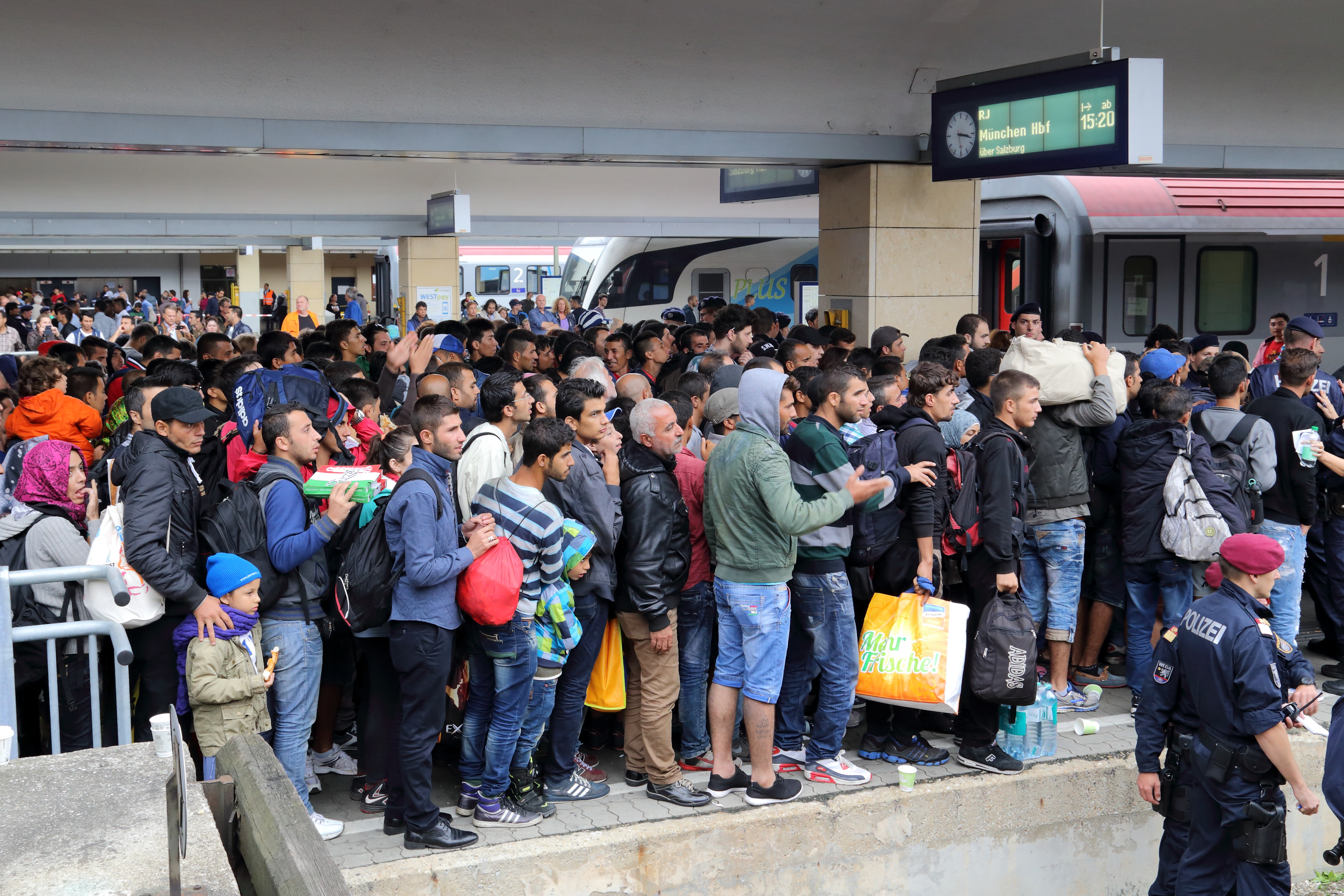
Refugees at Vienna Westbahnhof station, 5 September 2015

Refugees at Vienna Westbahnhof — 5 September 2015
Bwag / Wikimedia Commons CC BY-SA 4.0

2015 autumn

Peak Salience: Immigration Tops the Polls

By September 2015 immigration had overtaken the NHS as the single most cited concern in UK opinion polling (Ipsos Issues Index) — reaching 54 %. The chart on the right shows the full time series: immigration concern rises through the UKIP surge of 2012–14, spikes dramatically in summer 2015 with the Mediterranean crisis, and remains elevated through the referendum campaign.

Crucially, the spike has nothing to do with actual EU net migration to the UK, which remained broadly stable (and actually fell slightly) in this period. The dotted line shows net migration; the solid line shows public concern. They decouple completely in 2015. This is the confounding alternative pathway on the DAG: the EU immigration path (shown in red) represents not a genuine data correlation but a media-constructed perception.

The tabloid press ran near-daily crisis coverage. David Cameron was locked into his referendum promise. The referendum narrative was now fully formed: the EU meant uncontrolled immigration, and immigration meant the crisis on the Mediterranean.

Immigration salience vs. net migration, 2008–2025

Solid line: % citing immigration as most important issue (Ipsos Issues Index). Dashed: UK net migration (000s). Vertical markers: UKIP breakthrough 2013, Mediterranean crisis 2015, referendum 2016.

2015 May

The Election That Made Brexit Possible

The May 2015 general election is the hinge on which the entire Brexit story turns — and it is almost entirely a story about Britain's First Past the Post voting system operating in a three-plus-party environment.

UKIP won 12.6 % of the popular vote — the third-largest vote share of any party. Under a proportional system, that translates to roughly 83 MPs. Under FPTP, it translated to one seat. The votes were spread too thinly across too many marginals to win anywhere.

The vote-split mechanism: UKIP drew support from areas with high austerity exposure and depressed public services — communities that had been Conservative, Labour, or Lib Dem voters. In constituencies where the Lib Dems were defending seats, the new UKIP vote split the anti-Coalition vote, causing Lib Dem losses disproportionate to their total vote decline.

The Liberal Democrats lost 49 of their 57 seats. The Conservatives, whose support was concentrated in safer, more rural and suburban seats, gained.
David Cameron won a slim outright majority with 37 % of the popular vote — winning 331 seats vs. Labour's 232. He was now governing alone. He had made the referendum promise in January 2013 expecting another coalition, where a partner (the Lib Dems or Labour) would have blocked it. He was called on a promise he never expected to have to keep.

The causal chain suggests: austerity → UKIP surge (Panel B) → UKIP vote split in 2015 → Lib Dem wipeout → Conservative majority → referendum called. The referendum was not an inevitable product of public demand — it was a political accident created by First Past the Post.

2015: The Vote Split That Changed Everything

UKIP's 12.6% national vote produced one seat. The vote split, concentrated in austerity-hit communities, fell hardest on the Liberal Democrats. Cameron won a majority he hadn't expected.

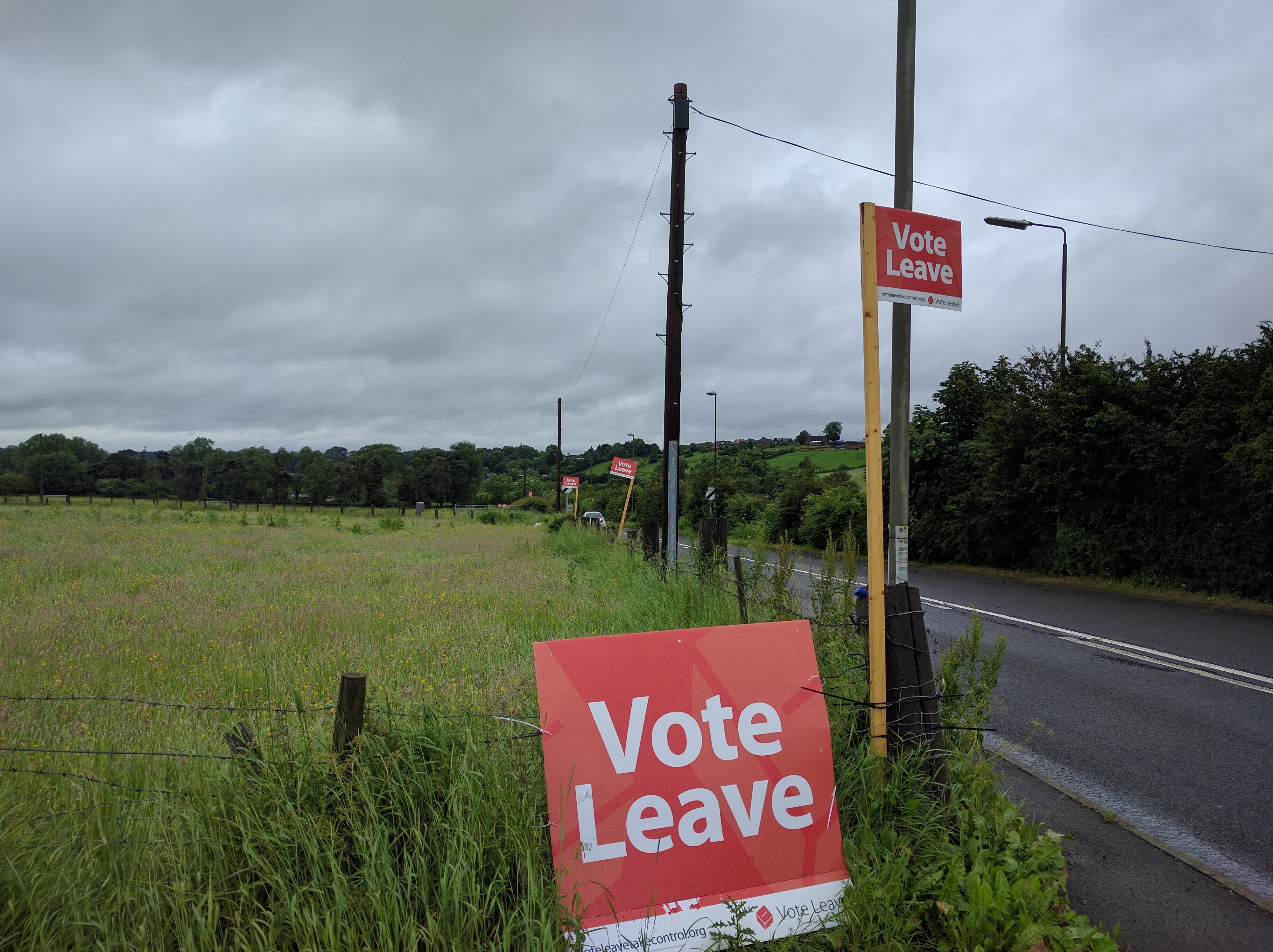
Vote Leave sign in Belper, Derbyshire

Vote Leave sign in Belper, Derbyshire — an austerity-hit community in a marginal Lib Dem seat
Wikimedia Commons

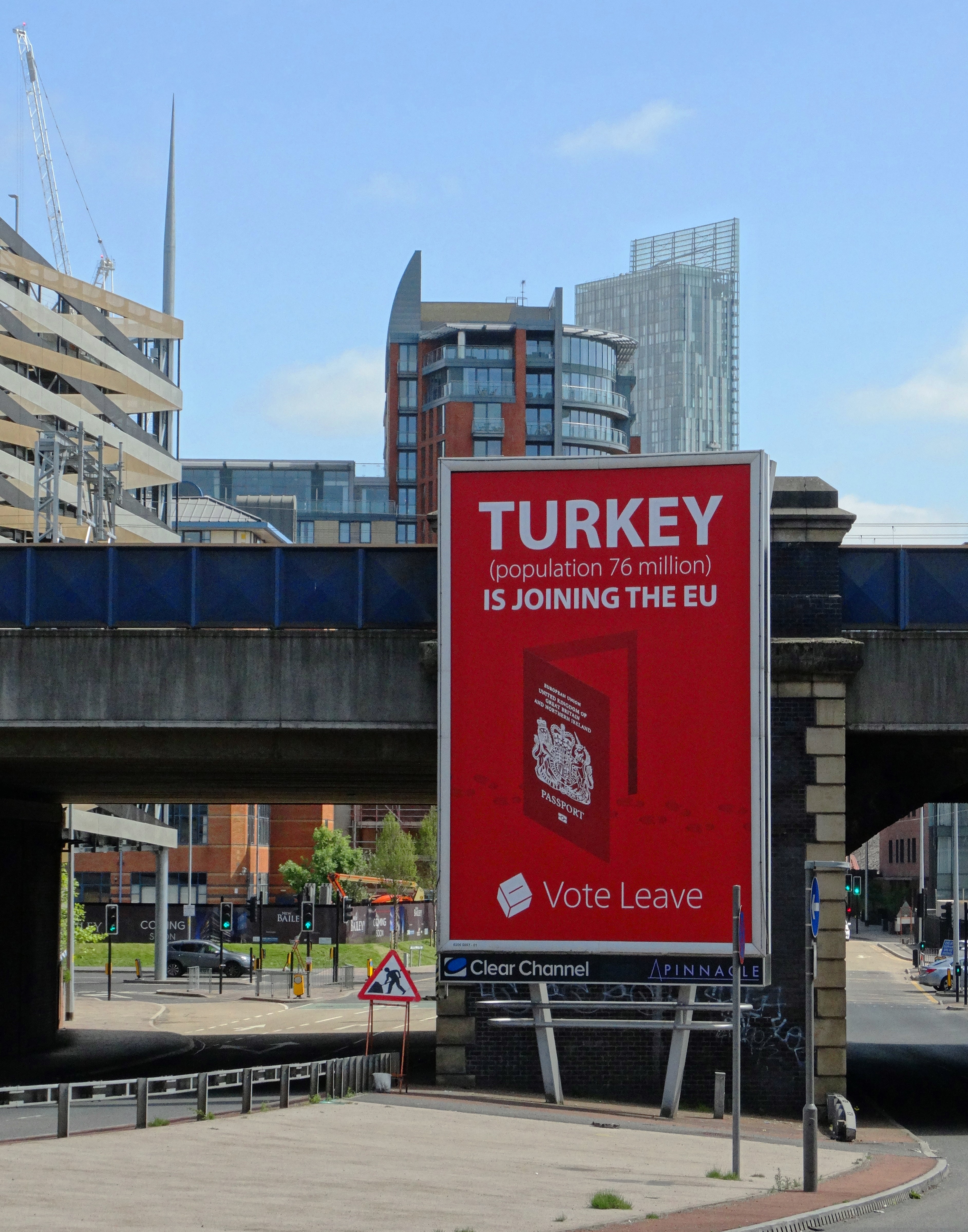
Vote Leave hoarding in Salford

Vote Leave hoarding in Salford — a Labour heartland where UKIP had surged in 2013–14
Wikimedia Commons

2015 seats vs. votes: UKIP 12.6% → 1 seat. Lib Dems 7.9% → 8 seats (from 57). Conservatives 37% → 331 seats (majority). First Past the Post converted a three-party popular vote into a two-party outcome — and gave Cameron a majority he hadn't expected and couldn't refuse.
2016

The Referendum Campaign

Following a renegotiation of membership terms, Cameron announced the referendum for 23 June 2016. The Leave campaign's central claim — "£350 million a week for the NHS" — directly connected EU membership to the austerity of public services. It was factually misleading (the figure ignored the UK's rebate) but politically lethal: it told communities whose hospitals, libraries, and schools had been cut that EU budget contributions were the cause.

The Mediterranean refugee crisis imagery was woven into the campaign. Nigel Farage unveiled a poster showing a long line of migrants with the caption "Breaking Point." The poster deliberately conflated Syrian refugees (not EU citizens, not using freedom of movement) with EU freedom of movement. The strategy was to activate the residual fear from 2015 and redirect it toward EU membership.

The campaign images on the right show this fusion in practice: Vote Leave posters linking immigration directly to NHS funding, ground-level canvassing in austerity-hit areas, and the Leave/Remain juxtaposition on the same street.

The Referendum Campaign: NHS, Sovereignty, Immigration

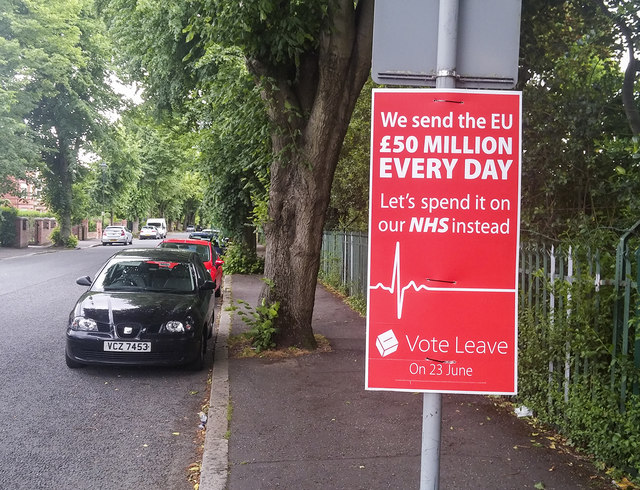
The Vote Leave campaign linked EU membership directly to NHS underfunding — the £350m/week claim. It fused two grievances that austerity had created: underfunded public services and visible social change.

Vote Leave NHS poster 2016

Vote Leave poster prominently featuring the NHS claim — the strategy of linking EU budget contributions to NHS underfunding
Wikimedia Commons

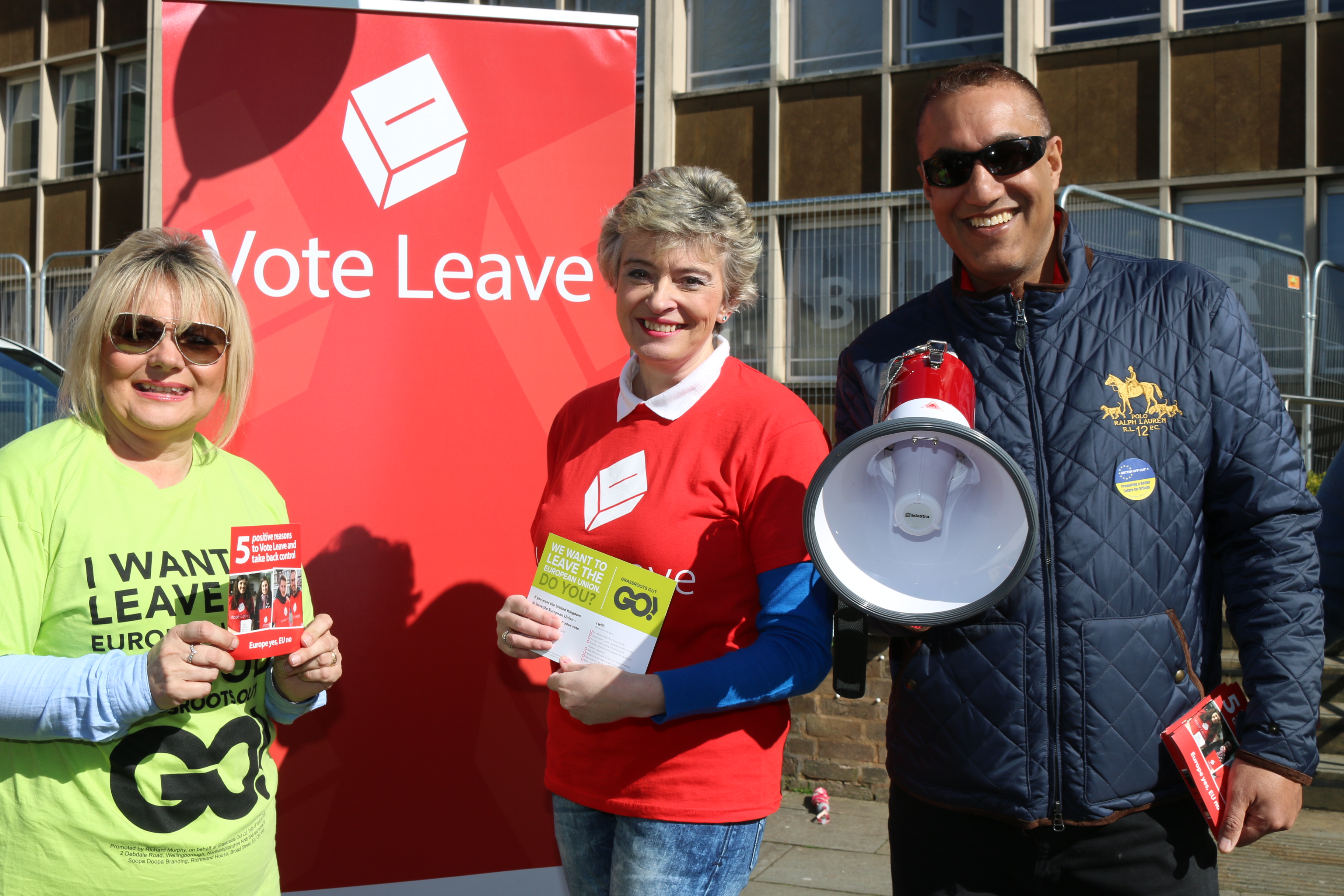
Vote Leave campaign group in Warwick, May 2016

Vote Leave campaign group in Warwick, May 2016 — ground-level mobilisation in a market town with high austerity exposure
Wikimedia Commons

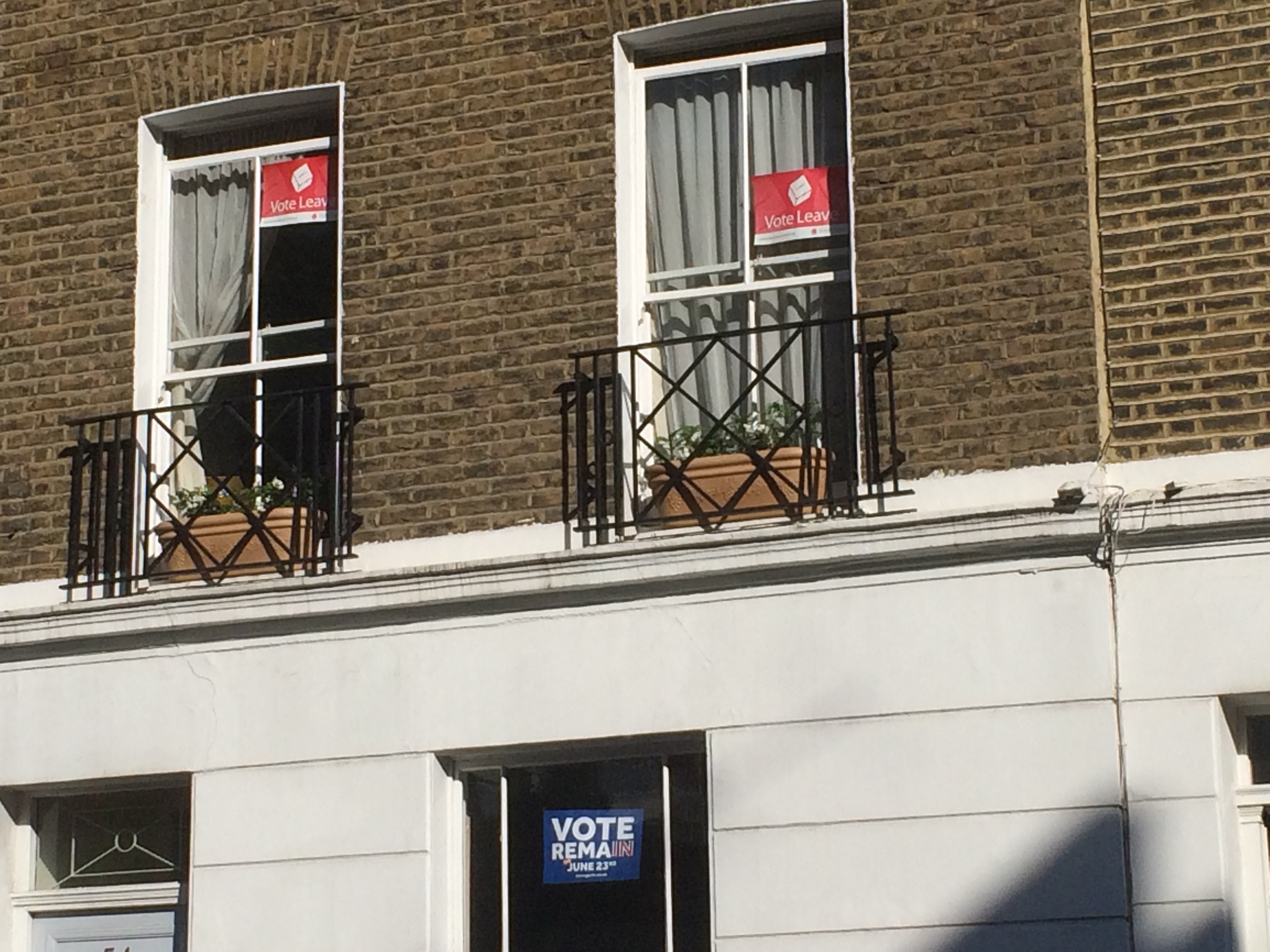
Leave and Remain posters side by side in Pimlico, June 2016

Leave and Remain campaign posters side by side, Pimlico, London — June 2016
Wikimedia Commons

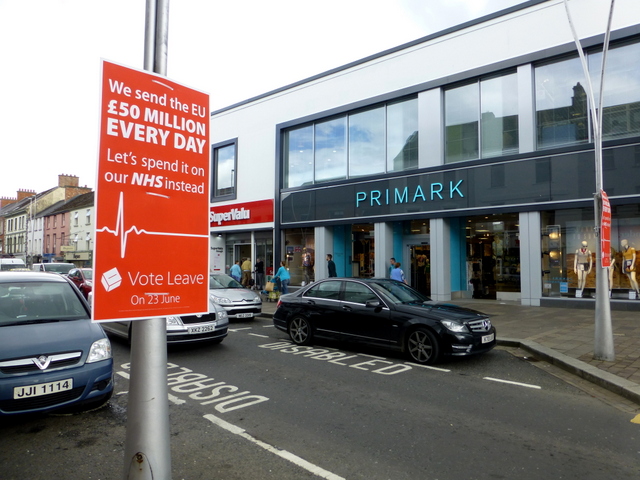
Vote Leave poster in Omagh

Vote Leave poster in Omagh, Northern Ireland — the campaign reached every corner of the UK
Wikimedia Commons

Facebook ad archive layer

One campaign,many Brexits

The referendum campaign did not only connect austerity and immigration. On Facebook, it also turned Brexit into a variable policy object. Different voters could be shown different implied Brexits: less regulation, more protection, lower bills, more hospitals, global openness, or border panic.

The exhibit below uses real ad creatives released through the UK Parliament/DCMS inquiry, coupled with metadata on the advertisements: was Brexit actually needed to do what the ad implied?

BeLeave ride-home regulation ad Vote Leave animal welfare ad Vote Leave Turkey/Syria border ad Vote Leave NHS hospital ad
Tension 1

Control as deregulation — or control as stronger prohibition?

The same master slogan, take back control, points in opposite policy directions. In one version, control means removing EU rules from everyday life. In another, control means using sovereign power to impose tougher moral protections.

Less regulation

“The EU should not be regulating your ride home.”
deregulation “The EU should not be regulating your ride home.” BrexitCentral/BeLeave, creative 2880. Spreadsheet theme: EU controls regulations; take back control of regulations.
“Get EU regulators out of the way.”
market freedom “Get EU regulators out of the way.” BrexitCentral/BeLeave, creative 2882. Prosperity is framed as removing external regulators.
VS

More protection

“Control of our animals and their welfare?”
protective regulation “Control of our animals and their welfare?” Vote Leave, creative 2951. The text says EU law blocks a UK ban on live transport of livestock for slaughter.
“This is not okay. Stop animal abuse.”
moral enforcement “This is not okay. Stop animal abuse.” Vote Leave, creative 2971. EU payments are linked to bullfighting and animal cruelty.
Tension 2

Free-market Brexit — or worker-protection Brexit?

A second contradiction is ideological. One ad family promises a brighter, competitive Britain once EU regulators and protectionism are removed. Another says the EU acts for big business against workers, and asks people to vote Leave to protect worker rights.

The policy platform is elastic: pro-business competitiveness for one audience; anti-big-business labour protection for another.

Market liberalism

“Trade deals create jobs. But the EU won’t let us make them.”
global markets “Trade deals create jobs. But the EU won’t let us make them.” BeLeave, creative 2888. The spreadsheet frames EU protectionism as blocking key trade deals.
“We just need to get EU regulators out of the way.”
anti-regulation “We just need to get EU regulators out of the way.” BeLeave, creative 2882. A competitive future is framed as deregulation.
VS

Worker protection

“The EU acts in the interests of big business.”
anti-corporate “The EU acts in the interests of big business.” Vote Leave, creative 3042. Campaign text: the EU acts against workers.
“The EU puts pressure on unions and workers rights.”
labour rights “The EU puts pressure on unions and workers rights.” Vote Leave, creative 3043. The call-to-action is “Protect Worker Rights!”
Tension 3

Global openness — or border panic?

The campaign could sound cosmopolitan: a fair immigration system, talent from all over the globe, non-discrimination, new trade deals. But another stream used maps, arrows, Syria, Iraq and Turkey to turn EU membership into a border emergency.

The same “control” frame can mean openness to global skills or closure against a fantasised frontier threat.

Open global Britain

“A fair immigration system that doesn’t discriminate.”
global talent “A fair immigration system that doesn’t discriminate.” BeLeave, creative 2887. Campaign text: bring in talent from all over the globe.
“Welcomes people with the skills we need.”
skills system “Welcomes people with the skills we need.” DUP Vote to Leave, creative 2903. Better borders are framed as skills selection.
VS

Border threat

“Turkey has a 511 mile border with Syria.”
phantom emergency “Turkey has a 511 mile border with Syria.” Vote Leave, creative 3046. Turkey accession is made visually proximate to the UK.
“Turkey has a population of 76 million.”
border panic “Turkey has a population of 76 million.” Vote Leave, creative 3047. Demographic scale is turned into a threat cue.
False necessity

The locked door that was not locked

The deeper pattern is not only contradiction. It is false necessity: Brexit was advertised as the key to powers that were already partly or wholly available inside the EU.

This matters because the political claim was not merely “we prefer Leave.” It was often “you cannot get this outcome unless you Leave.”

🔓

Non-EU immigration

The UK already controlled immigration rules for non-EU/non-EEA nationals. Brexit was needed to end EU free movement, not to design a skills system for the rest of the world.

False necessity
🔓

Worker rights

EU labour law generally sets minimum floors. Member states could provide stronger worker protections while remaining inside the EU.

Already possible
🔓

NHS spending

The NHS was already a domestic spending choice. EU membership did not stop the UK funding hospitals, and the gross £350m/week framing was criticised as misleading.

Domestic choice
🔓

Turkey accession

EU enlargement requires unanimous approval and national ratification. As a member state, the UK already had veto power over Turkish accession.

Phantom emergency
⚠️

VAT and bills

Some EU VAT constraints were real, especially on zero-rating at the time. But the ad generalized a narrow constraint into a broad promise of lower family bills.

Exaggerated constraint
⚠️

Animal welfare

A full unilateral live-export ban was more genuinely constrained. This is better read as a contradiction with anti-regulation ads than as pure false necessity.

Mixed case
Fiscal contradiction

Lower bills — or more hospitals?

The same sovereignty dividend was implicitly allocated in different directions: lower taxes and household bills in one ad stream; new NHS capacity in another.

“Better for family budgets. Lower bills.”
tax cut “Better for family budgets. Lower bills.” DUP Vote to Leave, creative 2902. Campaign text: leaving means the UK can set its own taxes and lower bills.
“Enough to build a new NHS hospital every 7 days.”
public spending “Enough to build a new NHS hospital every 7 days.” Vote Leave, creative 3086. The £350m/week claim is converted into hospital capacity.
same imagined money → two incompatible promises
One more scroll

This just made you scroll a bit.

Almost like, well, ..., social media?

Scroll once more to return to the story
2016 Jun 23

Leave Wins — 52 %

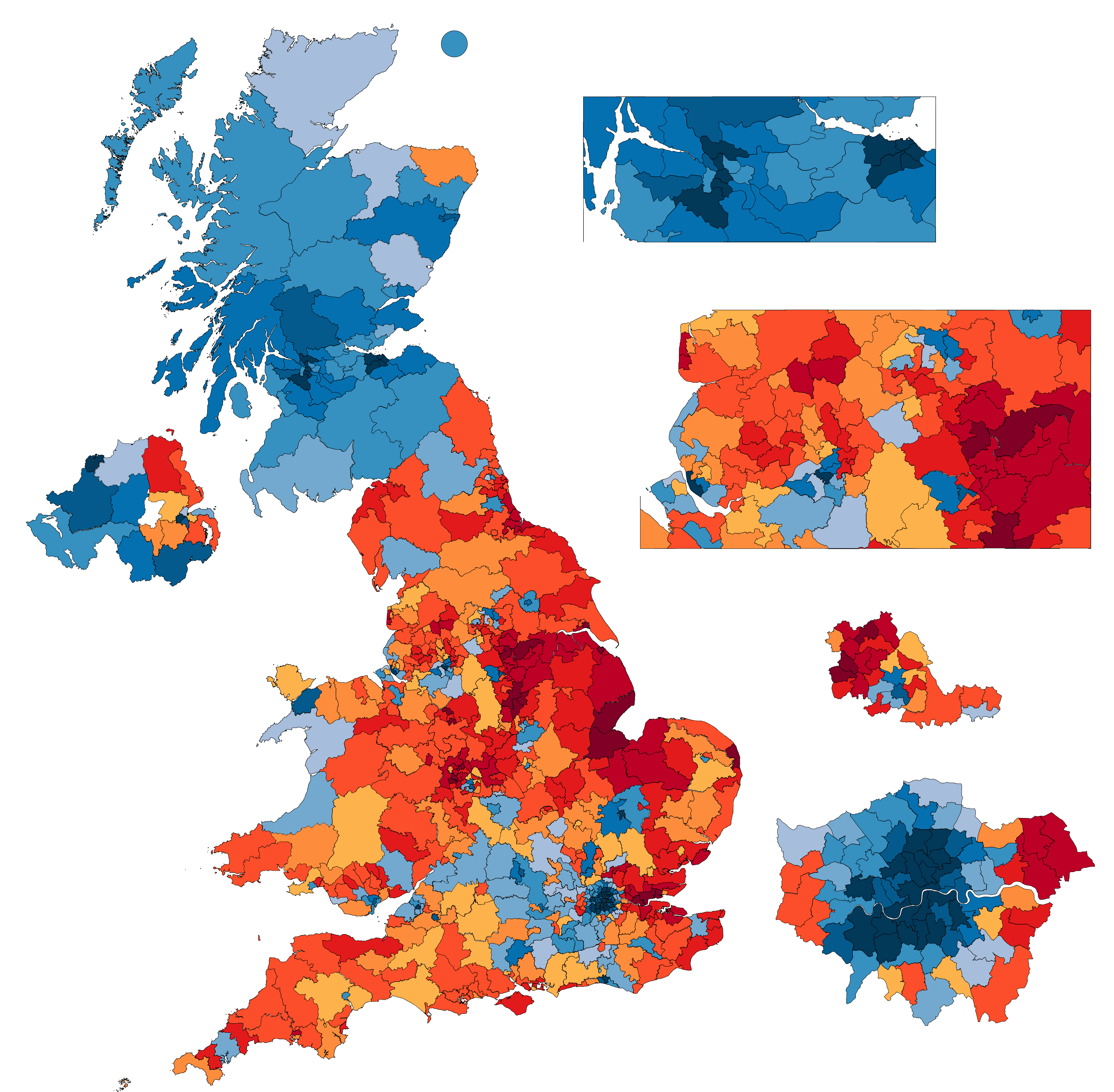
Leave won 52 % to 48 %. The geographic map was stark. The highest Leave shares clustered in post-industrial towns of the Midlands, North East, and Wales — areas with the highest austerity exposure and, paradoxically, the lowest EU accession immigration. London, Scotland, and Northern Ireland voted strongly Remain.

The result chart (Panel E) shows the correlation directly: higher Leave vote shares are associated with larger Brexit costs as a share of GVA. The places that voted most emphatically for change have since borne the largest relative costs of the change they voted for.

52%Leave vote share nationally
75.6%Boston (highest in England)
75%+South Staffordshire, Castle Point, Thurrock

23 June 2016: The Result

Leave 52%, Remain 48%. The geographic pattern was stark: the deepest red areas coincide almost perfectly with the highest-austerity, lowest-EU-immigration areas.

EU Referendum result map — Leave (red) vs Remain (blue)

EU Referendum result map — Leave (red) vs Remain (blue). The deepest red areas correlate strongly with the highest austerity index scores.
Wikimedia Commons

Cardiff for Europe event, June 2016

Cardiff for Europe event, shortly after the result — cities and university towns that voted Remain
Wikimedia Commons

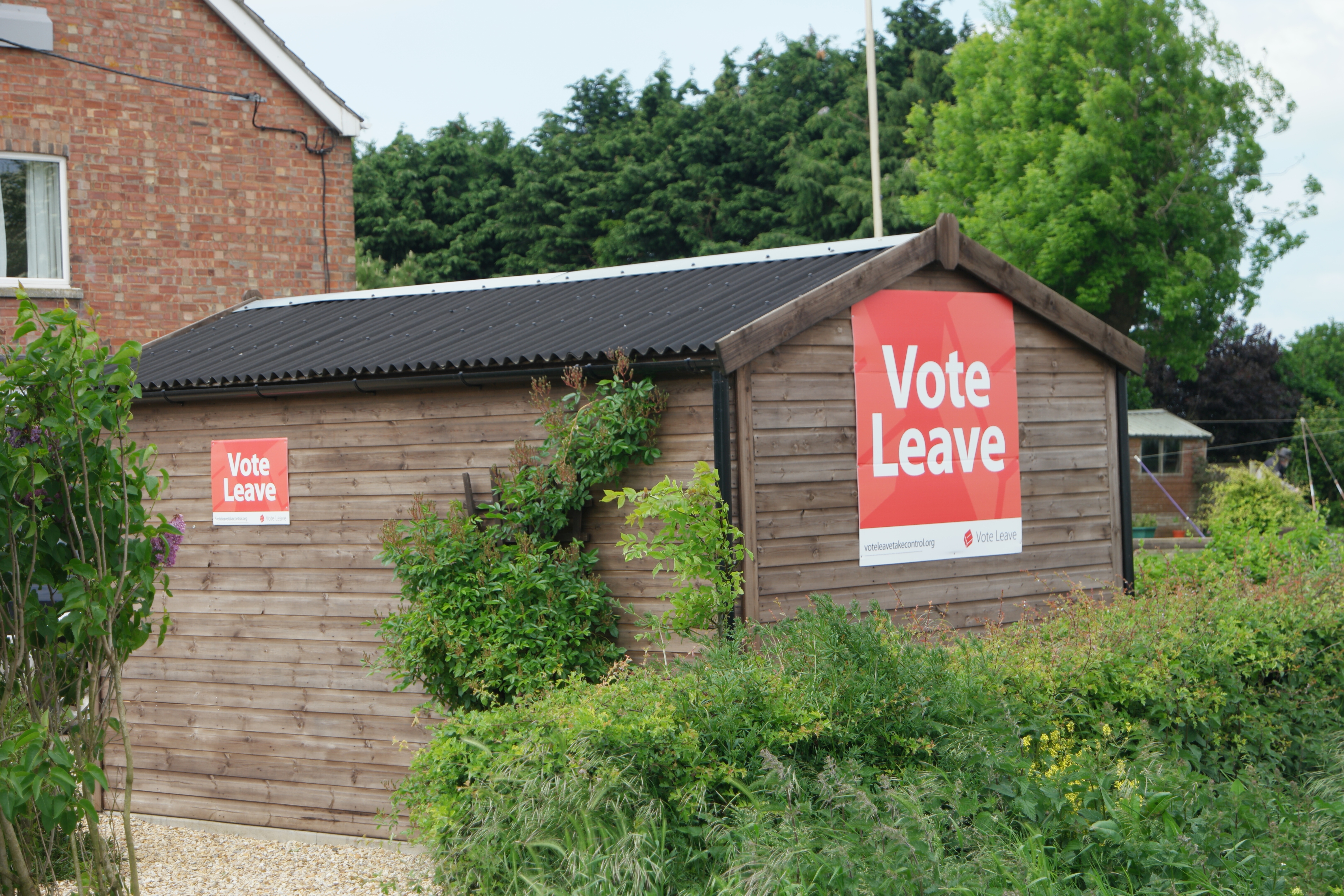
Isolated shed with Vote Leave sign

Vote Leave sign on an isolated building — the rural and small-town England that delivered the Leave majority
Wikimedia Commons

Outlier spotlight

Boston: An outlier in two dimensions

Most high-austerity areas had low EU immigration — the two narratives ran on parallel tracks without physically intersecting. Boston, Lincolnshire (highlighted in orange in the scatter plot, right) is the exception.

A market town and agricultural hub, Boston received one of the highest concentrations of Eastern European workers in England, drawn by vegetable harvesting, food processing, and logistics — particularly from Poland and Lithuania after the 2004 EU enlargement. At the same time, Boston's council budget was cut sharply under austerity. Public services visibly deteriorated: GP waiting times lengthened, school places became tight, A&E pressure rose.

The result: 75.6 % Leave — the highest in England. Boston sits in Panel C's top-right quadrant (high austerity, high immigration) yet voted Leave almost as decisively as any purely low-immigration, high-austerity place. This shows that where both factors coincided, the anger was amplified rather than attenuated. Immigration was not abstract here — it was real and visible — but the economic anxiety driving the Leave vote was still rooted in austerity, not immigration.

Panel C (right) is the confounder quadrant. Boston sits in the top-right (high austerity, high immigration), annotated in orange. Its Leave vote defies the simple "high immigration = Leave" narrative — it shows that austerity was the necessary condition, and immigration (where visible) was the available proximate cause.

C. Austerity × EU Immigration — the confounder quadrant

Austerity index (x) vs EU accession migrant growth 2001–11 (y). Quadrant shading = mean Brexit gap per cell. Orange ring = Boston (E07000136), highest Leave vote in England.

2016 Jun–Jul

Boston in the Media: The Exception Became the Rule

After the referendum result, Boston became the most-cited symbol of the Leave vote in national media coverage. BBC News, Sky News, and Channel 4 all ran features in the town in the days after the result. Interviews with Boston Leave voters were broadcast nationally and interpreted as representative of why Britain voted Leave.

The problem: Boston was the exception, not the rule. Its combination of high EU immigration and high Leave vote was unique precisely because its EU immigration was so visible. The majority of high-Leave areas had very little EU immigration. The immigration narrative — compelling and vivid in Boston — was being generalised to explain a phenomenon that, everywhere else, had almost nothing to do with immigration.

This media amplification locked in the incorrect causal narrative: "people voted Leave because of immigration." It crowded out the more accurate and more troubling story: "people voted Leave because a decade of austerity had left them with a legitimate grievance, and the campaign gave them immigration as the explanation."

The distinction matters enormously for policy. The "immigration caused Brexit" narrative implies that restricting immigration would have prevented it or would satisfy the underlying grievances. The "austerity caused Brexit" narrative implies that the underlying grievances remain intact — and have since been compounded by Brexit's own economic costs.

But even the word "austerity" can mislead, if it conjures only Treasury spreadsheets and GDP charts. The actual experience of the grievance was granular and daily. Middle England cities and towns were asking — not rhetorically, but in the ordinary course of life — why their local bus route had been cancelled. Why the swimming pool had been sold off, rebranded, and now cost twice as much to enter. Why the planning portal crashed every time you submitted an application. Why it took forty-five minutes on hold to speak to the council about a missed bin collection. Why Transport for London — with its Oyster card, its real-time apps, its frequent and comprehensible network — felt like a piece of infrastructure from a different country, available only to the people who happened to live where the money was.

This was not abstract. These were the touchpoints through which the state made itself legible — or stopped doing so. The decade after 2010 was the decade in which local government quietly stopped being something people encountered as a functioning service and became something they encountered as an absence: a closed library, a defunded youth centre, a website that told you to call a number that put you on hold. The grievance that Brexit crystallised was partly about trade exposure and public spending aggregates, but it was also about this: the daily experience of a state that had retreated, and left nothing in its place.

The relevant Brexit voter is not only the agricultural worker in Boston competing with EU labour. It is also the resident of a medium-sized English town watching the leisure centre close, the bus timetable shrink, and the council website fail — and being told, by a campaign with a red bus and a large number, that the explanation and the remedy were both the same thing: leaving the European Union.

The Leave Vote in Rural and Small-Town England

Boston's story — high immigration, high austerity, highest Leave vote — became the face of Brexit in national media. But most Vote Leave communities looked like this: small towns with visible decline and very little EU immigration.

Vote Leave sign in Belper

Vote Leave sign in Belper, Derbyshire. Belper is in an area with average EU immigration but high austerity exposure — more representative than Boston of the typical Leave community.
Wikimedia Commons

Will Brexit ever mean Brexit — Northumberland coastline

"Will Brexit ever mean Brexit?" — a question painted on a coastal wall in Northumberland, a region with high austerity and low EU immigration
Wikimedia Commons

2017 June

The Election That Hardened Brexit

Theresa May called a snap election in April 2017, expecting to convert her slim inherited majority into a commanding mandate for Brexit negotiations. The UKIP coalition that had reshaped British politics in 2013–15 had now served its purpose — the referendum had been won — and its voters were looking for a new home.

The UKIP vote collapsed from 12.6 % in 2015 to 1.8 % in 2017. Where did those votes go? The redistribution was uneven and — for May — fatal. In Leave-voting Labour heartlands, a substantial portion went to Labour under Jeremy Corbyn, who ran a genuinely radical domestic programme that addressed the economic anxiety underlying the UKIP vote. In more Conservative-leaning areas, UKIP votes went to the Conservatives. But the net seat effect was devastating.

The FPTP paradox, second edition: Labour's gains concentrated in urban seats already safely Labour. Conservative gains in traditional seats were insufficient to offset unexpected losses in university towns and some northern constituencies where Corbyn mobilised younger voters and former UKIP supporters simultaneously. The Conservatives lost 13 seats. Their majority evaporated.

May needed to form a minority government with a confidence-and-supply deal with the Democratic Unionist Party (DUP). This arrangement, combined with the paper-thin majority, meant that a bloc of 28–35 hardline Conservative Eurosceptics — the European Research Group (ERG) — now held genuine veto power.

2017: UKIP Collapses, Parliament Hangs

UKIP's vote fell from 12.6% to 1.8%. The redistribution left May without a majority. An anti-Brexit protest in Edinburgh, March 2017 — weeks before May called the snap election.

Brexit protest outside Holyrood, Edinburgh 2017

Brexit protest outside Holyrood, Edinburgh — March 2017. Scotland voted 62% Remain; opposition to Brexit was the defining political force.
Wikimedia Commons

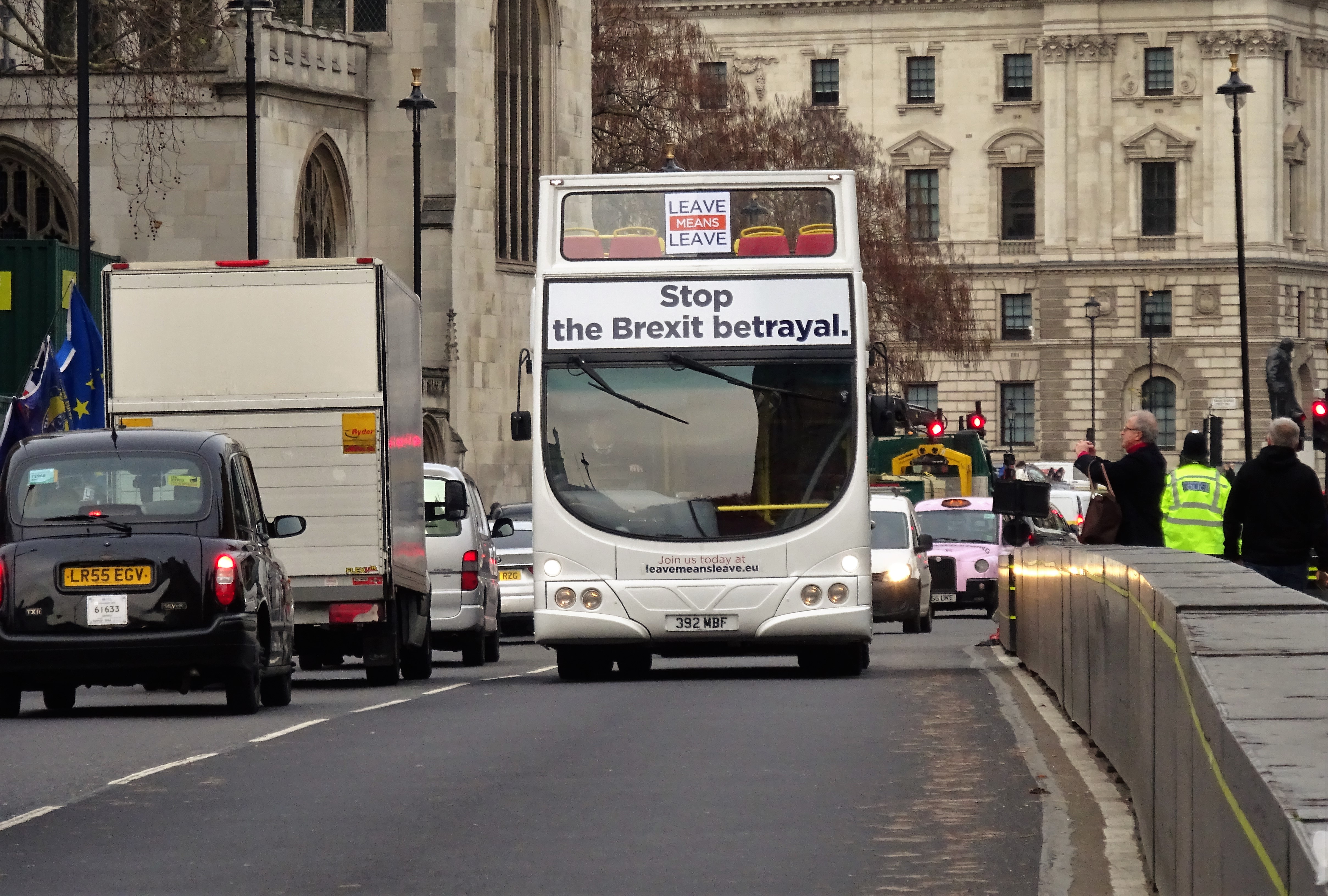
Leave Means Leave bus outside Parliament, 2018

"Leave Means Leave" campaign bus outside Parliament, December 2018 — ERG-aligned activists maintaining pressure for the hardest possible Brexit as May's deal faced its first defeat
Wikimedia Commons

2017 result vs expectation: May called the election with a 20-point poll lead. She finished with a 2-point lead, losing 13 seats, losing her majority. UKIP's 10.8pp drop redistributed partly to Labour (+9.6pp), partly to Conservatives (+5.5pp) — but the seat geography favoured neither side.
2017–2019

Parliamentary Deadlock: May's Trap

May was caught in an impossible trap. The DUP would not accept any arrangement that created a regulatory or customs divergence between Northern Ireland and the rest of the UK — this meant the Irish backstop was politically untenable. The ERG would not accept any arrangement that kept the UK bound by EU customs or regulatory rules — this meant a Norway-style soft Brexit was equally untenable.

May's withdrawal agreement was rejected by parliament three times — by margins of 230, 149, and 58 votes — the largest legislative defeats in modern British history. Each rejection hardened the political reality: only the most maximal Brexit was politically viable for the parliamentary arithmetic.

Boris Johnson's solution — accept the Northern Ireland Protocol (a de facto customs border in the Irish Sea, separating Northern Ireland from Great Britain in regulatory terms) and call it "getting Brexit done" — was only possible after securing his own 80-seat majority in December 2019. The hard Brexit that resulted was not the inevitable consequence of the 52–48 referendum result. It was the product of two FPTP electoral accidents, a minority government, and a constitutional veto by a small parliamentary bloc.

Parliament vs. Brexit: The Constitutional Crisis

May's deal was defeated three times. The People's Vote campaign mobilised millions. Boris Johnson's December 2019 majority finally broke the deadlock.

Brexit vote in Parliament, 15 January 2019

Outside Parliament on 15 January 2019, the night May's deal was rejected by 230 votes — the largest parliamentary defeat of a government in modern British history
Wikimedia Commons

People's Vote march in Parliament Square

People's Vote march in Parliament Square — one of the largest political demonstrations in British history, calling for a second referendum
Wikimedia Commons

People's Vote march — NHS vs Brexit banner

"NHS vs Brexit" — the People's Vote march reframed the debate: was Brexit worth the cost to public services?
Wikimedia Commons

Anti-Brexit campaigners at Westminster

Anti-Brexit campaigners at Westminster, 2018 — the parliamentary impasse created space for sustained public mobilisation
Wikimedia Commons

2019 December

FPTP Round Three: The Brexit Party Gambit

Nigel Farage's answer to the parliamentary deadlock was to found yet another party. The Brexit Party — launched in February 2019 — won 29 seats in the European Parliament elections just months later, becoming the UK's largest party in Brussels. It was a national brand built almost entirely through social media, requiring no prior organisational infrastructure: the internet had solved the collective action problem that historically made single-issue parties impossible under FPTP.

When Boris Johnson called a general election for December 2019, Farage faced the classic FPTP dilemma: field candidates everywhere and split the Leave vote, handing seats to Remain-aligned parties; or deploy strategically. He chose deployment. The Brexit Party stood down in all 317 Conservative-held seats, removing any risk to incumbent Tories. But they kept candidates in Labour-held seats — specifically in Leave-voting Labour heartlands across the Midlands, the North, and Wales.

The FPTP arithmetic, third edition: In marginal Labour seats in heavily Leave-voting areas, a Brexit Party vote of 5–8% was enough to drag Labour below the winning threshold. The Conservatives gained 47 seats from Labour — on swings that were, in many constituencies, smaller than the Brexit Party's local vote share. Without the Brexit Party's selective presence in those seats, the mathematics would not have delivered Johnson his majority.

The mechanism was the same as 2013–2015, but now operating in reverse: instead of using FPTP to punish Conservatives into holding a referendum, Farage was using it to reward Conservatives who would deliver the hardest Brexit. A nationally-branded, socially-networked, single-issue candidacy — requiring no deep local organisation, just enough presence to move the marginal vote — had become the decisive instrument of British constitutional change for the third time in six years.

Johnson's 80-seat majority ended three years of parliamentary paralysis. But it was not a majority built on a surge of Conservative support — the Conservative vote share rose by only 1.2 percentage points from 2017. It was a majority built on the systematic exploitation of FPTP's core vulnerability: that a nationally coordinated signal, delivered through social media at near-zero cost, can convert a modest national vote share into a decisive seat advantage by concentrating the effect in the marginals that decide governments.

2019–2020

Brexit Negotiations and the Shape of Departure

The UK-EU Trade and Cooperation Agreement (TCA), concluded on 24 December 2020, was the thinnest possible deal: zero tariffs and zero quotas on goods, but no mutual recognition of services, no equivalence for financial services, no freedom of movement, and comprehensive non-tariff barriers from rules-of-origin requirements, customs declarations, and regulatory divergence.

For the UK's service-dominated economy (80 % of GDP) the deal offered almost nothing. For manufacturing supply chains deeply integrated with EU production, it imposed new frictions immediately. For regions whose economies depended on EU-linked services exports — financial services in London, professional services in Edinburgh, creative industries in Manchester — the non-tariff frictions proved more costly than the headline zero-tariff commitment suggested.

The TCA was, by design, the outcome of a process shaped by the ERG's veto power and the Johnson government's political priorities. A softer Brexit — closer to Norway's EEA relationship, with regulatory alignment and freedom of movement — would have been less economically costly but was politically impossible given the parliamentary arithmetic that FPTP had created.

Northern Ireland: constitutional friction cushioned with cash

The Johnson settlement also sits inside a wider fiscal story: Northern Ireland was repeatedly stabilised with exceptional UK Government funding as Brexit exposed the unresolved problem of keeping an open Irish border while taking Great Britain out of the EU's customs and regulatory order.

  • 2017 — May, not Johnson: the DUP–Conservative confidence-and-supply deal supported Theresa May's minority government and came with an additional £1 billion over five years for Northern Ireland, including infrastructure, health, broadband, education pressures, deprivation and mental health.
  • January 2020 — Johnson's New Decade, New Approach: Johnson's government committed around £2 billion to support the restored Northern Ireland Executive and public services.
  • December 2020 — post-transition implementation: the UK announced a further £400 million Northern Ireland package, on top of £650 million already announced for trader support, technology and PEACE Plus contributions.

Sources: House of Commons Library, confidence-and-supply £1bn; UK Government, £400m post-transition package.

Brexit Negotiations and the Shape of Departure

Johnson's "Get Brexit Done" election majority in December 2019 ended the parliamentary stalemate. The Trade and Cooperation Agreement, concluded on 24 December 2020, was the thinnest possible deal; in Northern Ireland, the constitutional friction was accompanied by substantial UK fiscal support.

Boris Johnson Get Brexit Done campaign, 2019

Boris Johnson's "Get Brexit Done" campaign. His 80-seat majority in December 2019 ended three years of parliamentary paralysis — and locked in the hardest available Brexit.
Wikimedia Commons

HM Government Get Ready for Brexit campaign

HM Government "Get Ready for Brexit" campaign — October 2019. The £100m public information campaign was a measure of how unprepared businesses and individuals were for the practical consequences.
Wikimedia Commons

Brexit Day flag, Sandy Lane, Norwich, 31 January 2020

Union Jack flown in Sandy Lane, Norwich on Brexit Day — 31 January 2020. The UK formally left the EU. The transition period ended 31 December 2020.
Wikimedia Commons

Post-Brexit blues, European Parliament

UK MEPs leaving the European Parliament after the final plenary session, January 2020
Wikimedia Commons

2016 – present

The Reckoning: Leave → Cost

Synthetic control method (SCM) counterfactual estimates show substantial cumulative GVA losses, largest as a share of regional income in the most deprived areas — those that voted most heavily for Leave. The chart on the right (Panel E) shows this directly: Leave vote share on the x-axis, Brexit cost on the y.

The "levelling up" promise became a levelling down reality. The communities that were told Brexit would redirect money from Brussels to their public services have instead seen a decade of austerity compounded by a decade of post-Brexit underperformance. The cumulative gap between UK performance and the synthetic control counterfactual continues to widen.

The full causal chain is now visible and evidenced. Austerity created the anger. The Mediterranean crisis provided the imagery. FPTP in 2015 created the referendum. FPTP in 2017 hardened its outcome. The Brexit Party in 2019 locked it in. The communities that voted most emphatically for change got the least of it.

Brexit has reduced the economic pie for the country as a whole. It has reduced the fiscal space and reduced the ability to level up. In relative terms, the Brexit-voting regions may feel vindicated — but on average, the country as a whole is poorer. The end result: more disgruntlement and more instability.

This matters beyond Britain's borders. Russia's war in Europe, aggression from the US under Donald Trump, an assertive China, and the accelerating climate crisis make it all too transparent that shared challenges are best tackled as a team. The Brexit experiment has made that lesson more costly to learn.

E. Leave vote → Brexit cost

Leave vote share % (x) vs Brexit cost as % GVA (y, positive = more loss). Each bubble = a local authority; size ∝ √GVA 2016; colour = Brexit gap (red = larger loss). The upward slope is the central finding: those who voted most for Leave have paid most.

South East / ITL1 TLJ

What happened since Brexit?

Context and local drivers for South East.

South East
What happened since Brexit?

South East

Openness to trade and Brexit

To assess the economic impact on South East, a first natural consideration is the extent to which the region may have been impacted owing to its openness to trade. We compute the cumulative losses post 2016, also in a version excluding the pandemic years of 2020 and 2021, and plot the relative output loss relative to 2016 GVA against a measure of local trade openness based on subnational trade data first published in 2019.

Trade openness and Brexit's estimated economic cost

Why start here

To assess the economic impact on South East, a first natural consideration is the extent to which the region may have been impacted owing to its openess to trade. We compute the cumulative losses post 2016, also in a version excluding the pandemic years of 2020 and 2021, and plot the relative output loss relative to 2016 GVA against a measure of local trade openess based on subnational trade data first published in 2019.

We see that, on average, regions with more trade exposure exhibit higher output losses. As we move to more granular regional definitions, owing to measurement noise, the correlations do get weaker, but the pattern suggests that trade openess is not unrelated to the size of the output loss.

We see that, on average, regions with more trade exposure exhibit higher output losses. As we move to more granular regional definitions, owing to measurement noise, the correlations do get weaker, but the pattern suggests that trade openness is not unrelated to the size of the output loss.

This is not unexpected: Brexit is, what economists call, a terms-of-trade shock — it created frictions in the UK’s most significant trade relationship. The European single market, in which the UK was a member until the start of 2020, had effectively removed barriers to trade.

Brexit reimposed many of these barriers which, as a result, drove up the cost of trade. This is particularly consequential for the many value chains that criss-cross the European continent.

Changes to trade in South East

A key promise of Brexit was for the UK to regain its ability to negotiate trade deals with other, potentially faster growing countries or regions. Further, there is and was hope that trade in the future may be much more shaped by services—not goods—trade. We do see that, on average, the UK’s trade in services has grown.

How did South East trade evolve since Brexit?

From 2019 to 2023, total trade in the South East rose moderately, with gains spread across all four channels but led most clearly by EU goods and non-EU services.

Total trade increased from £220.9bn in 2019 to £248.7bn in 2023, a rise of £27.8bn or about 12.6%, so the overall pattern is one of growth rather than decline. Looking across the main channels, EU goods trade rose from £83.7bn to £95.8bn, up £12.2bn; non-EU goods rose from £67.4bn to £70.6bn, up £3.2bn; EU services rose from £29.4bn to £30.3bn, up £0.9bn; and non-EU services rose from £40.4bn to £51.0bn, up £10.6bn. That suggests a mixed pattern overall, with the largest absolute contributions coming from EU-facing goods and non-EU-facing services. Goods trade remained the larger block of trade in 2023, but services also expanded materially, especially outside the EU. This does not look like a simple shift in one direction only. EU trade and non-EU trade both increased in cash terms, with non-EU trade rising slightly more in absolute terms overall, while within goods the EU side strengthened more clearly and within services the non-EU side was the main source of growth. The region’s economic structure helps make that mix plausible: the South East has flagged exposure in transport and logistics, hospitality, and finance and professional services, while standout sectors include accommodation and food services, information and communication, and administrative and support services. Those features are consistent with a region that can generate both goods-linked trade flows and internationally traded services, including beyond the EU. At the same time, this stronger nominal trade picture sits alongside a much weaker estimated Brexit effect in output terms. The effect synthesis judges the South East a high-confidence Brexit “loser” on GVA, with observed 2023 GVA £65.0bn below the best synthetic path. That suggests rising trade values did not translate into a stronger real output path, and may reflect factors such as inflation, exchange-rate movements, pandemic recovery effects, commodity and import price changes, or sector-specific shocks rather than a straightforward improvement in underlying trade performance. The especially strong rise in imports relative to exports also points to caution in reading higher total trade values as unambiguously positive economic news.

📦EU vs non-EU trade growth, 2019–2023

How EU and non-EU goods & services trade evolved relative to 2016 GVA — x-axis: EU trade growth, y-axis: non-EU trade growth. Regions above the diagonal diversified away from the EU.

Bubbles:All regionssize ∝ √GVA 2016

Immigration and Brexit

Immigration is another important dimension around Brexit. In the run up to the EU referendum, many populist UK politicians adopted an explicit anti-immigration narrative. The promise to voters was that once the UK is outside of the European Union, there would be no more freedom of movement. The UK would take control over its national borders and, so the implicit understanding may have been, reducing the influx of immigration.

The contrary has happened. The UK has seen an unprecedented increase in immigration post 2020 with net international migration peaking at 944,000, being nearly three times the previous record. The UK’s new immigration scheme, which the UK could have adopted even before Brexit, is often credited for this sharp increase.

At the same time, there was significant domestic migration and displacement. Areas in the UK with significant internal net migration are typically not the places that receive significant international migrants. While the underlying causal factors may be manifold, this clearly can set up sharp anti-immigration narratives if domestic migrants perceive displacement from international migrants.

✈️Internal vs international net migration (post-2021)

Net internal displacement (x) vs net international arrivals per capita (y). Regions in the top-left gained international migrants while losing residents internally.

Bubbles:All regionssize ∝ √GVA 2016

How was South East affected by immigration since Brexit?

Migration into the South East looks large enough to matter locally, with a mixed but internationally led pattern after 2016 that became more concentrated after 2020, so it could have cushioned some Brexit-related weakness without overturning the area’s strongly negative estimated output effect.

Migration appears quantitatively large enough to matter in the South East. From 2016 to the latest period, net total migration was about 512,299, equal to 5.7% of the 2016 population, while gross international immigration was about 908,239, or 10.0% of population; gross internal inflows were larger still at about 5 million, or 55.0% of population, though net internal migration was much smaller at 155,613, or 1.7%. This points to a mixed migration pattern overall, but with international migration likely the more important source of net population gain, since net international migration (3.9% of the 2016 population) exceeded net internal migration. The post-2020 period appears especially important for net change: about 82.9% of post-2016 net international migration and 69.6% of net internal migration occurred after 2020, which is consistent with migration becoming more concentrated in the later period.

South East / ITL1 TLJ

Robustness

Testing whether the divergence is robust to donor-pool choice, treatment window, and placebo comparison.

Metric
Treatment window

Sensitivity to donor-pool choice

Observed levels against alternative donor-pool synthetic fits.

Observed level against all candidate synthetic paths, shown from 2005 onward.
Each point is a donor-pool specification. Lower pre-treatment RMSPE is better; more negative post-treatment average gap implies a larger shortfall.

How to read donor-pool sensitivity

The left chart asks whether the observed path remains separated from a wide range of plausible synthetic benchmarks when the donor pool changes. The dropdown highlights one donor-pool family at a time, while the full set of grey lines shows the total design space tested.

The scatter plot summarises the same candidate set in two dimensions: pre-treatment fit on the x-axis and average post-treatment percentage gap on the y-axis. If highlighted donor pools cluster in the lower part of the chart while still fitting well before treatment, the result is less likely to be driven by a single arbitrary donor-pool choice.

Placebo-fits for significant donors

True placebo gap paths and their distribution from the robustness exports.

Gap paths on the SCM estimation scale for placebo units that pass the robustness filter, alongside the treated unit.
Distribution of placebo robustness statistics with the treated unit marked for reference.

How to read the placebo comparison

The placebo exercise carries out fake Brexit experiments in a donor universe and compares how, within this donor universe, the UK synthetic control would evolve relative to the synthetic-control estimate for the fake Brexit. Since we are constructing a large set of synthetic-control estimates, 31 for each potential donor-pool set configuration and different spatial granularities, doing this for all would be computationally infeasible.

Rather, we construct a restricted candidate set of potentially informative placebos that pertain to donors that are active donors across these donor-pool configurations. In these restricted placebo runs, an active donor does not simply mean a place that received a large synthetic-control weight in one model. It means a place that looked relevant to the counterfactual construction under a broader set of rules, including repeated appearance across admissible donor-pool specifications and support-based placebo diagnostics. The restricted donor universe should therefore be understood as a support-informed subset of plausible comparison places, not just the set of donors with visibly large weights in a single best-fitting specification.

Placebo-weighted fit. The pre-Brexit placebo-weighted fit uses a fake treatment date before the referendum, here a post-2012 placebo, to evaluate how well different synthetic-control specifications behave when no Brexit effect should yet be present. We take the same candidate donor-pool models that could later be used for the real post-2016 or post-2020 analysis and ask which specifications produce the smallest spurious gaps over the following pre-Brexit years when no such difference should arise. Those placebo-period errors are then turned into weights, so specifications that generate smaller false effects in the pre-Brexit placebo window receive more weight in the final ensemble.