← Change place
ITL3 · Northern Ireland
TLN06
OverviewThe Brexit StoryWhat happened since Brexit?Local StoriesRobustness
Northern Ireland / Northern Ireland / ITL3 TLN06
ITL3 TLN06

Belfast

Tracing the local economic footprint of Brexit through production and household income.

Belfast
GVA gap in 2023
£341m
GDHI shows the stronger divergence.
Average GVA gap since 2016
£347m
Persistent positive gap over the post-Brexit era.
GDHI gap in 2023
£372m
GDHI is nominal and may understate real effects.
How to read this place report
  1. Overview — headline output and income gaps and how they evolve.
  2. The Brexit Story — the causal chain from austerity and immigration panic to the Brexit vote and its economic costs.
  3. What happened since Brexit? — trade exposure, immigration, and interpretive context.
  4. Local Stories — mapped reporting and evidence linked to this geography.
  5. Robustness — placebos, donor pools and method notes.

1. Headline outcomes

Metric
Treatment window
Gross Value Added (GVA)
£ million (real chained-volume measure, nominal for GDHI)
GVA · Post-2016
The post-2016 gap is around £341m in 2023 (2% vs. synthetic path).
GVA gap path
Observed minus synthetic control (£m)
By 2023 the GVA gap is £341m relative to the synthetic path.
Reading the result
  • In the post-2016 GVA window, observed real output is £16.9bn in 2023 against a best synthetic £16.6bn, a gap of £0.3bn or +2.1%. That is not a clear loser pattern by the latest year, because the observed path sits slightly above the best synthetic comparison.
  • The post-2016 GVA path is mixed rather than one-way: the gap is positive in 2016-2019, drops to -£0.9bn in 2020, then returns to +£0.5bn in 2022 and +£0.3bn in 2023. Across all post-2016 years combined the cumulative gap is about +£2.8bn, which points to volatility around the best path rather than a lasting shortfall.
  • The post-2020 GVA window complicates the earlier picture: observed real output is £16.9bn in 2023 versus a best synthetic £17.3bn, a gap of -£0.4bn or -2.4%, and the path stays below in 2021-2023. Its cumulative post-2020 shortfall is about £2.4bn, equivalent to roughly £1,169 per person in 2023 and £6,878 per person cumulatively, so the later-window estimate is more negative than the post-2016 window.
  • GVA is the cleaner local-output measure here: it is production-side and measured as real chained-volume output, while GDHI is nominal resident income and can include transfers, pensions, capital income, social security, and labour income earned elsewhere. GDHI is still useful context — in 2023 its gap is +£0.4bn in the post-2016 window and +£0.2bn in the post-2020 window, versus GVA gaps of +£0.3bn and -£0.4bn — but the classification remains based on GVA.
Northern Ireland / Northern Ireland / ITL3 TLN06

Local stories

Local reporting linked to Belfast.

Belfast
Local stories

Belfast

18 distinct local stories are currently linked to Belfast. Coverage runs from 2021 to 2026. The dominant storylines revolve around Export barriers, Costs & paperwork, and Labour & staffing, with the most common cited channels being Customs and border administration, Regulatory burden or simplification, and Expectations and narratives.

  • 11 of 18 stories describe a negative local effect, most often through Customs and border administration, Regulatory burden or simplification, and Expectations and narratives.
  • The most common local story themes are Export barriers (16), Costs & paperwork (14), and Labour & staffing (10).
  • 8 stories cite a concrete figure or reported statistic, including mid-2027 target for new SPS agreement and 41% of exporters disagreed that the Brexit deal was helping grow sales; only 14% agreed.
Mechanisms most cited

18 linked stories

Customs and border administration
6
Regulatory burden or simplification
5
Expectations and narratives
2
Global value-chain disruption
2
Wage and employment channel
2
FDI and location choice
1
Common themes
Export barriers
16
Costs & paperwork
14
Labour & staffing
10
Relocation & investment
9
Delays & disruption
5
Sales & demand
5
Sectors most mentioned
Aerospace manufacturing / aircraft production network
1
Business services, trade and logistics / Northern Ireland dual access
1
Engineering services and professional qualification recognition
1
Exporters
1
Financial services, insurance and data analysis
1
Health services and skilled labour availability
1

Stories

The Guardian5 June 2026Music, live performance and creative exports

Belfast: musicians face lower EU work and tour earnings after Brexit

In Belfast, music venues, promoters and independent performers are exposed to the same post-Brexit touring barriers described in Guardian reporting on UK musicians. The report found that more than a quarter of UK musicians had lost all EU work since 2021, nearly half had seen EU opportunities reduced, average tour earnings had fallen by 45%, and 59% said European touring was no longer viable. For a city or regional music economy, the mechanism is a loss of exportable live-work opportunities, fewer inbound and outbound tours, weaker collaboration and lower income for small artists and venues that depended on frictionless EU mobility.

The Guardian28 May 2026Retail, food supply chains and GB-NI trade

Belfast: Retail, food supply chains and GB-NI trade Brexit impact

In Belfast and Northern Ireland’s retail supply chains, the new UK-EU food export agreement is relevant because it is expected to ease the Windsor Framework burden on supermarkets and food producers selling from Great Britain into Northern Ireland. The Guardian reported that, once the rules come into force, businesses selling into Northern Ireland will no longer require health labels for the covered food categories. For local retailers and wholesalers, the change would reduce labelling and certification friction that has made sourcing from Britain more complex since Brexit.

Reuters / Federation of Small Businesses5 May 2026SMEs / exporters

Belfast: Brexit impact on SMEs / exporters

In Belfast, small firms trading with the EU faced continuing post-Brexit pressure from red tape, rising costs and complex rules. Reuters reported Federation of Small Businesses research in May 2026 warning that small UK firms were being pushed out of EU markets as bureaucracy and operating costs made cross-border sales harder to sustain. The impact for local SMEs was a smaller reachable market: firms that had once treated nearby EU customers as ordinary export opportunities increasingly had to absorb customs administration, VAT complexity, delivery uncertainty and compliance work before a sale became worthwhile.

MusicRadar1 December 2025Music, cultural exchange and live touring

Belfast: artists organise to remove UK-EU touring barriers

In Belfast, the live music and cultural economy is affected by the barriers that led UK artists and industry bodies to form a coalition calling for easier UK-EU touring. MusicRadar reported that prominent musicians and organisations joined the Cultural Exchange Coalition after Brexit added costs and bureaucracy to cross-border performance. For local venues and artists, the implication is that lost EU mobility is not a one-off paperwork issue but an ongoing constraint on earnings, scheduling and collaboration.

The Guardian21 November 2025Health services and skilled labour availability

Belfast: health systems face loss of overseas-trained staff

In Belfast, health-service labour availability matters for local productivity because untreated ill-health and staffing shortages feed back into workforce participation. Guardian reporting said 4,880 overseas-trained doctors left the UK in 2024, a 26% rise, while 42% of the UK medical workforce had qualified abroad. For regional health economies, the issue is that a less welcoming post-Brexit labour environment can reduce retention of skilled staff, worsening waiting times and constraining local labour-market participation.

The Scottish Sun26 July 2025Northern Ireland retail food logistics

Belfast and Northern Ireland retail supply chains affected by Not-for-EU labelling and checks

In Belfast and the wider Northern Ireland retail economy, post-Brexit goods rules can interrupt supermarket logistics even for routine food products. The Scottish Sun reported parliamentary claims that supermarket lorries were stopped and delayed over custard labelling under Northern Ireland trade arrangements, causing shortages in some shops. The local channel is retail supply-chain compliance: mixed loads moving from Great Britain to Northern Ireland require labelling and documentation rules that can delay distribution and raise fixed costs for retailers.

British Chambers of Commerce30 January 2025Exporters

Belfast: Brexit impact on Exporters

In Belfast, exporters faced a weak growth payoff from the post-Brexit trading settlement. The British Chambers of Commerce reported in January 2025 that 41% of exporters disagreed that the Brexit deal was helping them grow sales, while only 14% agreed. The impact was felt through sales pipelines and confidence: firms trying to sell into EU markets faced paperwork, checks and rules that made growth harder, leaving local exporters with higher transaction costs and fewer easy routes to expand beyond the domestic market.

Reuters16 October 2024Financial services, insurance and data analysis

Belfast: financial services lose jobs and EU-facing activity after Brexit

In Belfast, finance and business-service clusters are affected by the post-Brexit relocation and market-access dynamics described by Reuters. The City of London’s Lord Mayor said Brexit had cost about 40,000 finance jobs, with activity absorbed by Dublin, Milan, Paris and Amsterdam, while financial output had weakened relative to other European economies. For regional financial centres, the mechanism is a loss of EU-facing mandates, fewer high-productivity jobs and lower tax/productivity spillovers from financial services.

Reuters14 August 2024Engineering services and professional qualification recognition

Belfast: engineers seek non-EU recognition routes after Brexit

In Belfast, engineering and technical-service firms are affected by post-Brexit professional-recognition frictions and by the search for alternative routes to market access. Reuters reported that UK and US engineering bodies reached a mutual-recognition agreement to make it easier for engineers to have qualifications recognised and provide cross-border services. For local engineering clusters, the relevance is that leaving the EU made recognition of professional services a live trade issue: firms need recognised credentials, mobile staff and trusted standards to sell services internationally.

The Guardian25 May 2024Tourism, visitor attractions and hospitality labour

Belfast: tourism attractions face staff shortages after Brexit

In Belfast, tourism and visitor-economy businesses are exposed to the same labour-market constraint described in Guardian reporting on royal residences and wider attractions. The article reported that tourism employers struggled to recruit front-of-house, retail and catering staff after Brexit and the pandemic, with UKHospitality estimating 132,000 vacancies and an 11% vacancy rate in the sector. For local tourism economies, the impact is reduced opening capacity, higher wage pressure, shorter seasons and weaker export earnings from visitors.

Belfast Telegraph31 March 2023Retail, logistics and manufacturing / GB-NI trade

Belfast: local press source candidate on Retail, logistics and manufacturing / GB-NI trade

In Belfast, Belfast Telegraph coverage of the Windsor Framework framed the post-Brexit trade settlement as a chance for Northern Ireland businesses to recover smoother GB-NI supply routes while preserving access to EU goods markets. For local retailers, manufacturers and wholesalers, the economic issue is not abstract sovereignty but the cost and predictability of sourcing goods across the Irish Sea. The evidence adds a local press perspective on how checks, green lanes, paperwork and dual-market access shape investment confidence and supply-chain planning in Belfast.

Belfast Telegraph12 March 2023Business services, trade and logistics / Northern Ireland dual access

Belfast: local press source candidate on Business services, trade and logistics / Northern Ireland dual access

In Belfast, Belfast Telegraph reporting on business leaders backing the Windsor Framework adds local evidence of firms trying to reduce the cost of post-Brexit uncertainty. The local business concern was that prolonged disputes over the Protocol had made GB-NI trade, investment planning and supplier confidence less predictable. The article family helps capture a distinct Northern Ireland mechanism: Brexit created trade frictions, but also a potential dual-access advantage if the rules become stable enough for firms to use.

Belfast Telegraph1 March 2023Retail, manufacturing and wholesale distribution

Belfast: Windsor Framework reaction, retail/wholesale supply chain checks and labelling burdens

In Belfast, reporting by Belfast Telegraph around Northern Ireland business community gives a localised account of Brexit's effect on retail, manufacturing and wholesale distribution. The source describes Windsor Framework reaction, retail/wholesale supply chain checks and labelling burdens. The local economic impact is that firms or supply-chain actors face additional checks, documentation, routing decisions or labour and cost pressures before goods can reach customers, reducing margins and making smaller consignments or time-sensitive shipments less viable.

Belfast Telegraph27 February 2023NI trade / retail / manufacturing

Belfast: Brexit impact on NI trade / retail / manufacturing

In Belfast, firms affected by the Northern Ireland Protocol looked to the Windsor Framework for relief from several years of trading friction. Belfast Telegraph reporting on business reaction to the February 2023 agreement described the private-sector focus on whether the deal would reduce paperwork and restore smoother GB-NI supply. The impact was concentrated in retail, manufacturing, food and distribution: businesses needed reliable input flows from Great Britain while also trying to preserve Northern Ireland’s distinctive access to EU goods markets.

Belfast Telegraph14 June 2021NI trade / manufacturing / retail

Belfast: Brexit impact on NI trade / manufacturing / retail

In Belfast, businesses trading across the Irish Sea faced Protocol-related friction after Brexit. The Belfast Telegraph reported in June 2021 that Northern Ireland business groups appealed to the UK Government and EU to return to talks to resolve trading difficulties. The impact was practical and day-to-day: firms bringing goods from Great Britain into Northern Ireland faced new declarations, supplier hesitation, delivery delays and uncertainty over whether established supply chains would keep working at acceptable cost.

Belfast Telegraph25 March 2021Retail, manufacturing and GB-NI distribution

Belfast: Retail, manufacturing and GB-NI distribution Brexit local/regional evidence

In Belfast, this local/regional source family points to Brexit-related pressure in Retail, manufacturing and GB-NI distribution. Northern Ireland firms described Protocol-related paperwork, checks and uncertainty as a continuing cost for goods moving between Great Britain and Northern Ireland. For local retailers, wholesalers and manufacturers, the issue sits in distribution and input availability: firms face declarations, route choices, compliance rules and higher fixed costs before goods reach shelves or workshops. For the evidence pack, the item is retained as a publication-ready local/regional article and is mapped to the relevant goods-trade or supply-chain mechanisms without using it as statistical evidence.

Belfast Telegraph25 March 2021Retail distribution / GB-NI trade

Belfast: GB-NI goods movement, protocol checks and business calls for a reset

In Belfast, reporting by Belfast Telegraph around Belfast / Northern Ireland gives a localised account of Brexit's effect on retail distribution / gb-ni trade. The source describes GB-NI goods movement, protocol checks and business calls for a reset. The local economic impact is that firms or supply-chain actors face additional checks, documentation, routing decisions or labour and cost pressures before goods can reach customers, reducing margins and making smaller consignments or time-sensitive shipments less viable.

The Times2024-09Aerospace manufacturing / aircraft production network

Belfast: Aerospace manufacturing / aircraft production network — How the Beluga kept Wales in the Airbus family

In Belfast, Aerospace and Spirit/Airbus supply-chain activity face the Brexit-related pressure described in The Times reporting on aerospace manufacturing / aircraft production network. The source records Airbus Broughton/Beluga production network sustains thousands of jobs across north Wales and UK aerospace supply chains. For Belfast, the local economic impact is that firms with EU customers or cross-border supply chains must absorb extra administration, delays, compliance work or route uncertainty before output reaches its market. This changes margins, customer reliability and investment incentives, particularly for smaller firms without large customs, logistics or regulatory teams.

Back
Back to overview
Return to the headline estimates and key findings
Explore
Robustness
Placebos, sensitivity checks, and the strength of the evidence
Belfast
The Full Story

How Britain Got Here

The conventional narrative of Brexit — that immigration drove the Leave vote — breaks down immediately when you look at the geography. The areas that voted most strongly to Leave were precisely those where EU immigration had been lowest. What they shared instead was a decade of austerity that hollowed out public services and stagnated wages.

But the political events that enabled Brexit — the referendum itself, and then the hardest possible form of it — required a specific chain of electoral shocks created by Britain's First Past the Post voting system operating in a multi-party environment. Scroll down to trace the full causal chain, with evidence at each step.

The DAG above highlights the relevant node or edge as each chapter comes into view. Charts and images appear on the right as the narrative develops.

2008

The Global Financial Crisis

The collapse of Lehman Brothers in September 2008 triggered the deepest global banking crisis since the 1930s. UK GDP contracted 4.2 % in 2009. Banks were recapitalised with public money. The fiscal position swung dramatically — a structural deficit that would define the next decade of British politics.

The crisis itself was concentrated in financial services and affected places like London and the South East most directly. But the political and fiscal response — the austerity that followed — would fall hardest on communities that had the least to do with the crash: post-industrial towns in the Midlands, North and Wales.

4.2%UK GDP contraction, 2009
£137bnPeak deficit as % GDP (2009–10)
£500bn+Public money committed to bank recapitalisation

The 2008 Shock

Selected UK macroeconomic indicators around the financial crisis

–4.2%
UK GDP growth in 2009 (worst since 1930s)
£500bn+
Public support committed to banking sector recapitalisation
10%
UK unemployment peak 2011 (from 5.2% pre-crisis)

The financial crisis created the fiscal deficit that would justify austerity — but its costs were socialised across communities that had not created it.

2010

Austerity Begins

The Cameron–Clegg Coalition's October 2010 Comprehensive Spending Review announced £83 billion in cuts over four years. The frame was national necessity: "we are all in this together." The reality was geographically uneven. Local government bore a disproportionate share — and local government spending was most critical to the communities already most economically fragile.

Between 2010 and 2015, English local authorities lost an average of 26 % of their real-terms funding. But the cuts were not distributed evenly. Councils serving the most deprived populations — which had higher needs and greater dependence on grant funding — faced cuts of 40 % or more. Libraries, youth centres, Sure Start children's centres, adult social care, and bus subsidies were hollowed out.

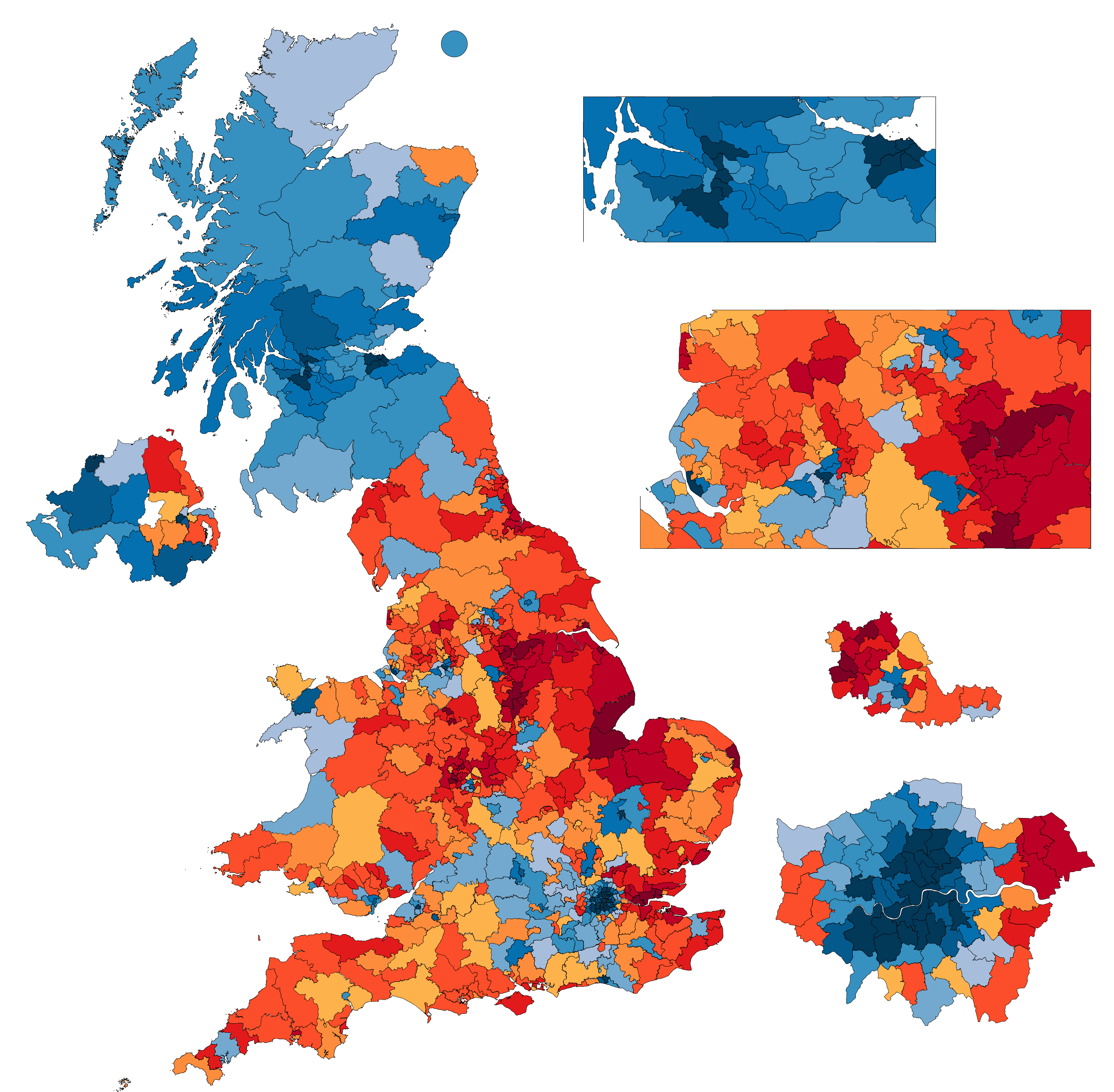
This is captured by the austerity index used in this analysis: a measure that combines both Welfare Reform Act impacts and local authority budget cuts between 2010 and 2015, capturing how areas were hit through multiple forms of large-scale spending reductions. The highest values cluster in post-industrial towns in the Midlands, North East and Wales — the same places that would later vote most heavily to Leave.

26%Average English council funding loss 2010–15
40%+Funding loss in most deprived councils
£83bnTotal announced cuts in 2010 CSR

Austerity by the Numbers

Local government funding cuts 2010–2015

Average English council funding loss –26%
Most deprived councils –40%+
Sure Start centres closed 2010–2019 1,000+
Public libraries closed 2010–2019 800+
2013

UKIP: Austerity's Political Voice

In the 2013 local elections UKIP won 23 % of the national vote, mostly in areas with low EU-origin immigration. This is the central paradox of the UKIP surge: it was loudest where EU migration was least visible.

Nigel Farage fused anti-austerity resentment with anti-immigration messaging. Communities that had experienced real decline — closed libraries, shuttered youth centres, longer NHS waiting lists — were given an explanation (immigration) and a villain (the EU). The cognitive dissonance was politically convenient: austerity was the cause, but it was politically harder to oppose than immigration.

The chart on the right (Panel B) shows this directly. The x-axis is the austerity index; the y-axis is UKIP vote share growth 2009–14. The upward slope is clear and consistent across all geographic levels. The chart asks whether austerity does more explanatory work than immigration in the UKIP surge.

UKIP's rise mattered structurally for two reasons: it put direct electoral pressure on David Cameron to call a referendum, and it would later (2015) split the vote in ways that completely reshaped the parliamentary map.

B. Austerity → UKIP growth

Austerity index (x) vs UKIP vote share growth, 2009–14 (y). Each bubble = a local authority; size ∝ √GVA 2016; colour = Brexit cost (red = larger loss).

2015 spring–summer

The Mediterranean Crisis

Crossings from North Africa and Turkey surged to a record 1.3 million arrivals in Europe. The "Jungle" camp outside Calais dominated UK front pages for months. Images of packed boats, fences, and tents were broadcast nightly into British living rooms.

These were almost entirely Syrian, Iraqi, and Afghan refugees — not EU accession workers under freedom of movement. Yet the political framing collapsed the distinction entirely. For millions of viewers, "immigration" became the Mediterranean crisis. EU freedom of movement — a 30-year-old policy governing movement between EU member states — was rhetorically fused with the refugee emergency unfolding on Greek and Turkish shores.

The key asymmetry: the refugee crisis was visible in a way that EU economic migration was not. Eastern European workers in a food processing plant in Lincolnshire were unremarkable to most British viewers. Boats crossing the Aegean were not.

The Mediterranean Crisis, 2015

These images — boats, fences, tents — dominated British television and front pages through summer and autumn 2015. They created the visual vocabulary for "immigration" that would define the referendum campaign.

Refugees arriving at Lesbos, October 2015

Refugees arriving at Lesbos — October 2015
Ggia / Wikimedia Commons CC BY-SA 4.0

Inflatable boat crossing from Turkey to Lesbos, January 2016

Boat crossing Turkey→Lesbos — January 2016
Mstyslav Chernov / Wikimedia Commons CC BY-SA 4.0

The Calais Jungle camp, 2015

The Calais "Jungle" — the image that defined the crisis in British media
Jean Revillard / Wikimedia Commons CC BY-SA 4.0
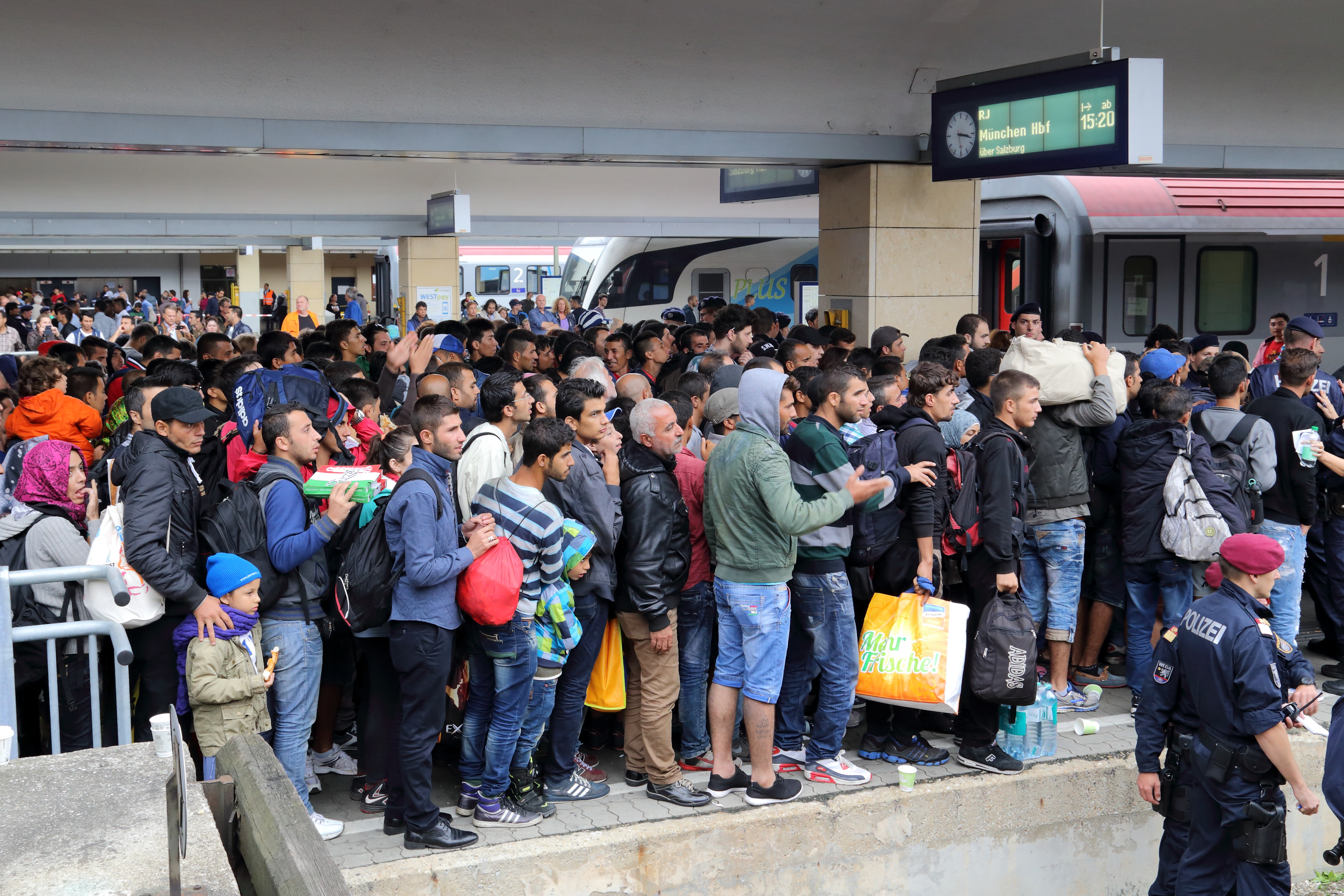
Refugees at Vienna Westbahnhof station, 5 September 2015

Refugees at Vienna Westbahnhof — 5 September 2015
Bwag / Wikimedia Commons CC BY-SA 4.0
2015 autumn

Peak Salience: Immigration Tops the Polls

By September 2015 immigration had overtaken the NHS as the single most cited concern in UK opinion polling (Ipsos Issues Index) — reaching 54 %. The chart on the right shows the full time series: immigration concern rises through the UKIP surge of 2012–14, spikes dramatically in summer 2015 with the Mediterranean crisis, and remains elevated through the referendum campaign.

Crucially, the spike has nothing to do with actual EU net migration to the UK, which remained broadly stable (and actually fell slightly) in this period. The dotted line shows net migration; the solid line shows public concern. They decouple completely in 2015. This is the confounding alternative pathway on the DAG: the EU immigration path (shown in red) represents not a genuine data correlation but a media-constructed perception.

The tabloid press ran near-daily crisis coverage. David Cameron was locked into his referendum promise. The referendum narrative was now fully formed: the EU meant uncontrolled immigration, and immigration meant the crisis on the Mediterranean.

Immigration salience vs. net migration, 2008–2025

Solid line: % citing immigration as most important issue (Ipsos Issues Index). Dashed: UK net migration (000s). Vertical markers: UKIP breakthrough 2013, Mediterranean crisis 2015, referendum 2016.

2015 May

The Election That Made Brexit Possible

The May 2015 general election is the hinge on which the entire Brexit story turns — and it is almost entirely a story about Britain's First Past the Post voting system operating in a three-plus-party environment.

UKIP won 12.6 % of the popular vote — the third-largest vote share of any party. Under a proportional system, that translates to roughly 83 MPs. Under FPTP, it translated to one seat. The votes were spread too thinly across too many marginals to win anywhere.

The vote-split mechanism: UKIP drew support from areas with high austerity exposure and depressed public services — communities that had been Conservative, Labour, or Lib Dem voters. In constituencies where the Lib Dems were defending seats, the new UKIP vote split the anti-Coalition vote, causing Lib Dem losses disproportionate to their total vote decline.

The Liberal Democrats lost 49 of their 57 seats. The Conservatives, whose support was concentrated in safer, more rural and suburban seats, gained.

David Cameron won a slim outright majority with 37 % of the popular vote — winning 331 seats vs. Labour's 232. He was now governing alone. He had made the referendum promise in January 2013 expecting another coalition, where a partner (the Lib Dems or Labour) would have blocked it. He was called on a promise he never expected to have to keep.

The causal chain suggests: austerity → UKIP surge (Panel B) → UKIP vote split in 2015 → Lib Dem wipeout → Conservative majority → referendum called. The referendum was not an inevitable product of public demand — it was a political accident created by First Past the Post.

2015: The Vote Split That Changed Everything

UKIP's 12.6% national vote produced one seat. The vote split, concentrated in austerity-hit communities, fell hardest on the Liberal Democrats. Cameron won a majority he hadn't expected.

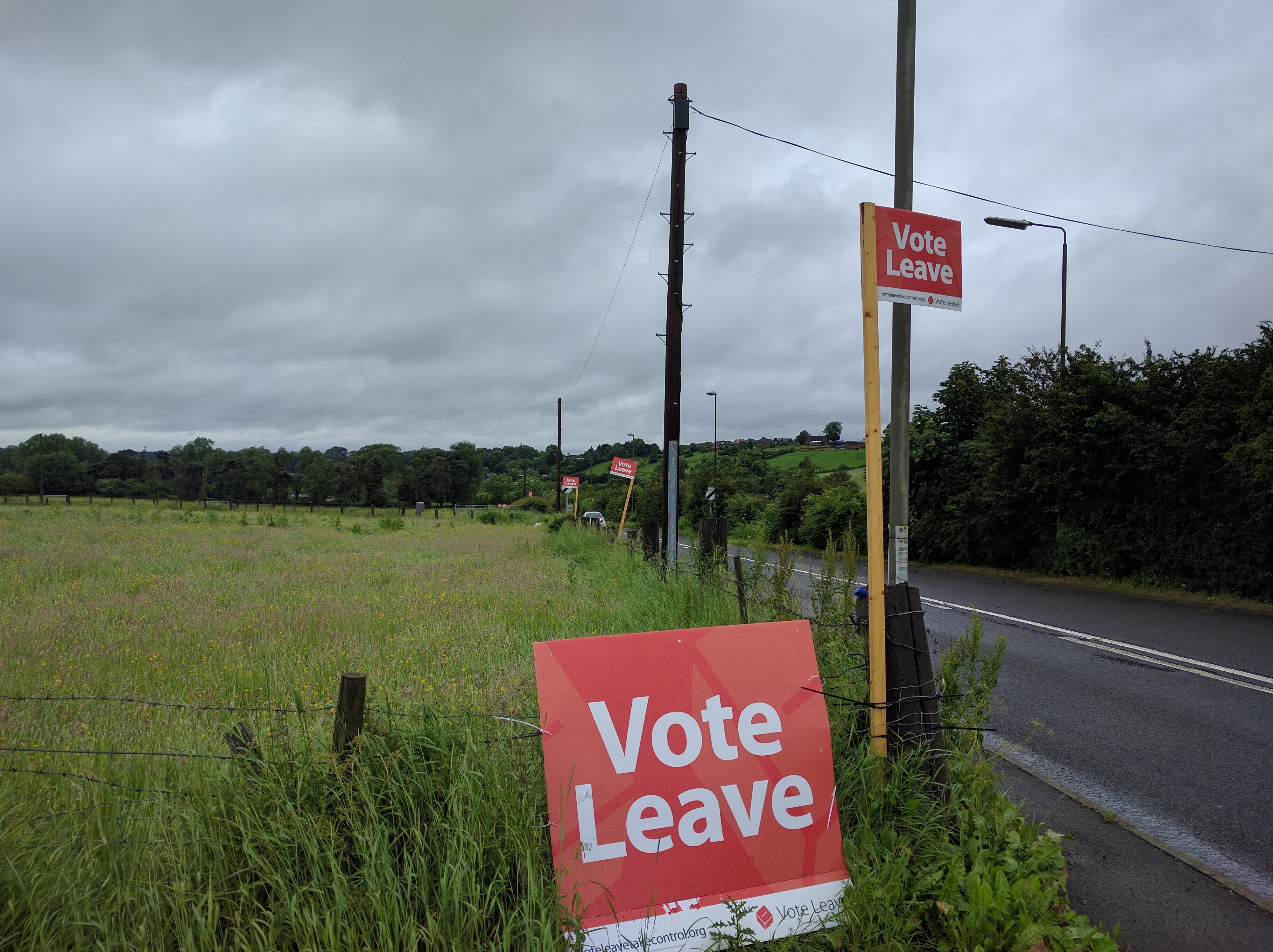
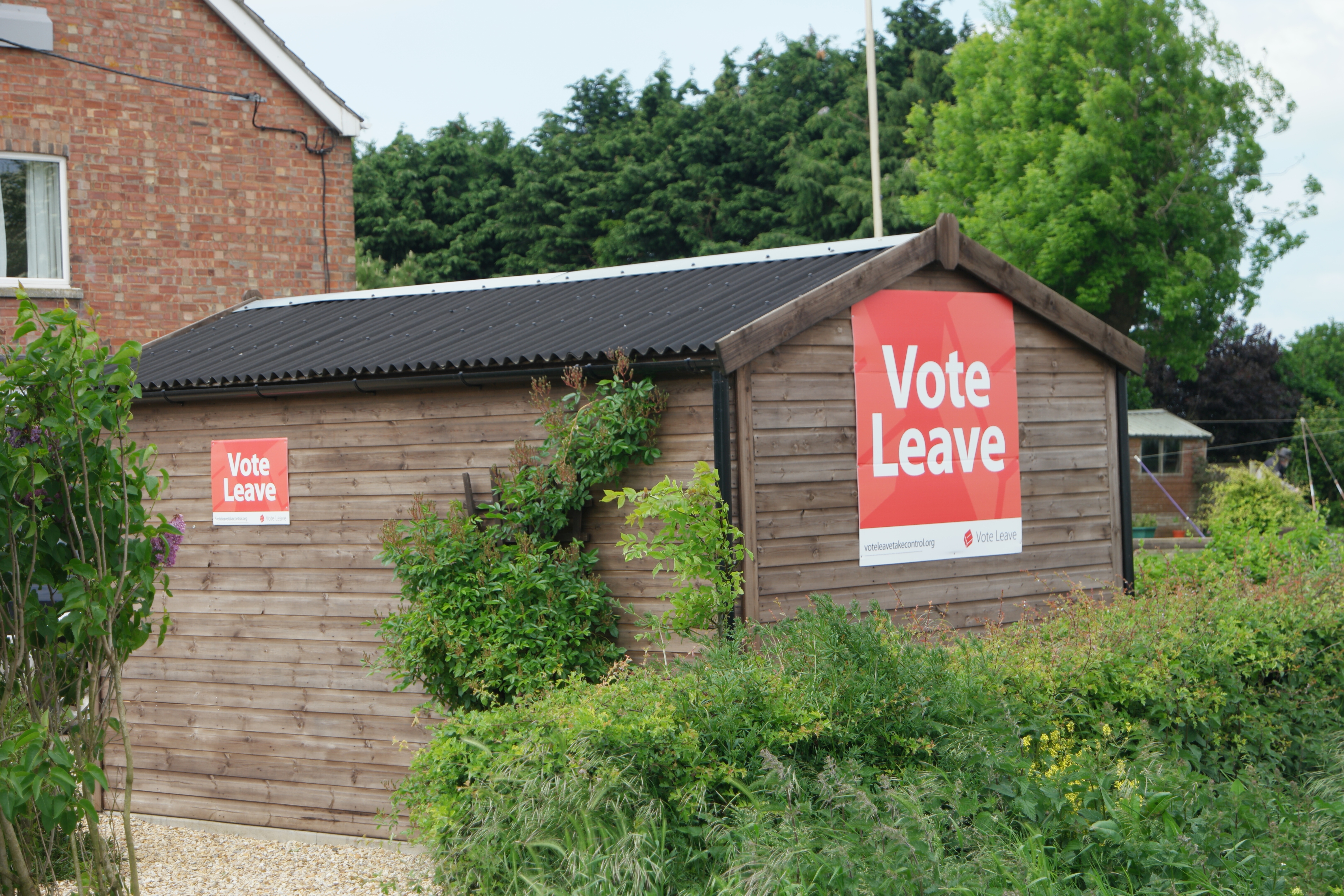
Vote Leave sign in Belper, Derbyshire

Vote Leave sign in Belper, Derbyshire — an austerity-hit community in a marginal Lib Dem seat
Wikimedia Commons
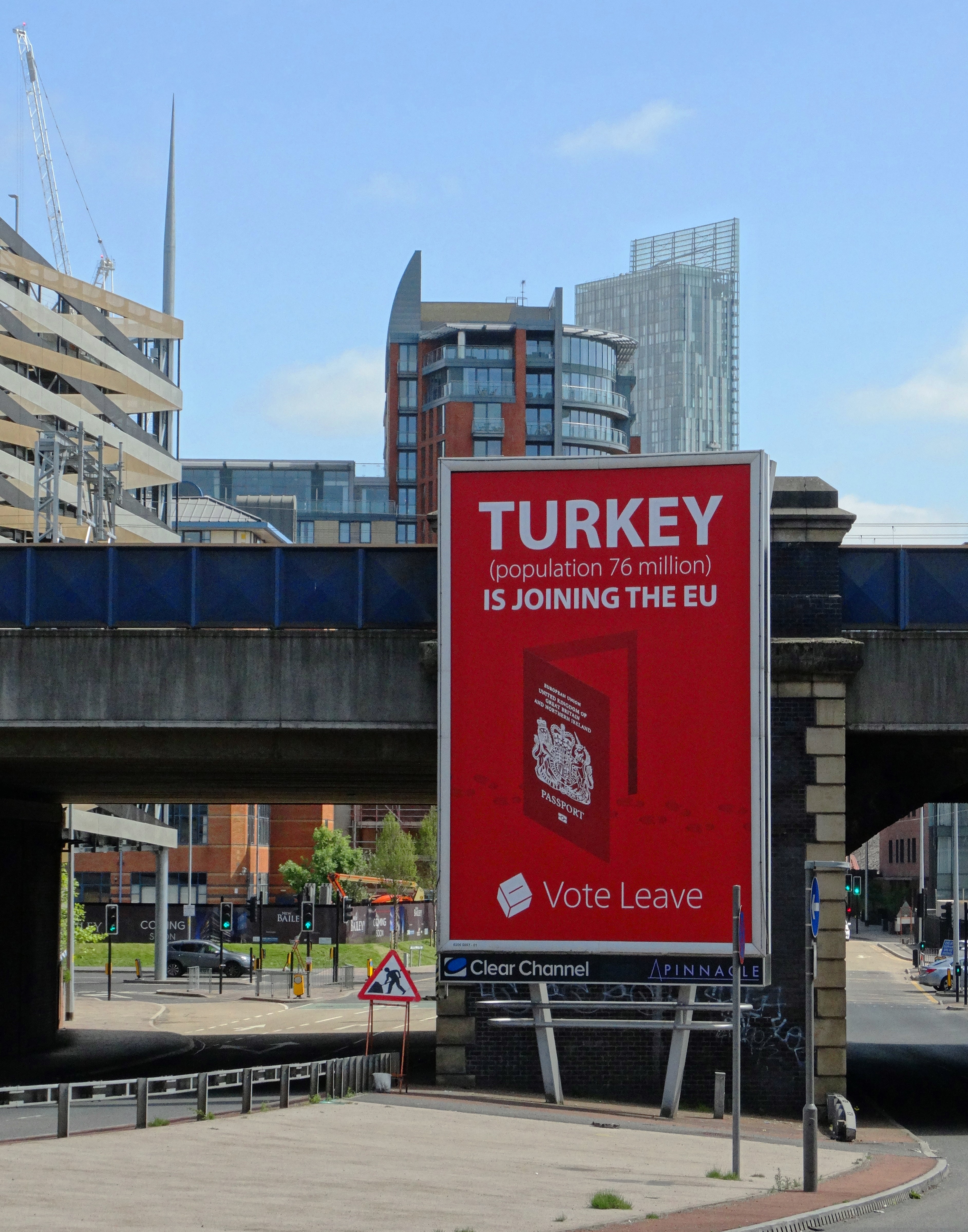
Vote Leave hoarding in Salford

Vote Leave hoarding in Salford — a Labour heartland where UKIP had surged in 2013–14
Wikimedia Commons
2015 seats vs. votes: UKIP 12.6% → 1 seat. Lib Dems 7.9% → 8 seats (from 57). Conservatives 37% → 331 seats (majority). First Past the Post converted a three-party popular vote into a two-party outcome — and gave Cameron a majority he hadn't expected and couldn't refuse.
2016

The Referendum Campaign

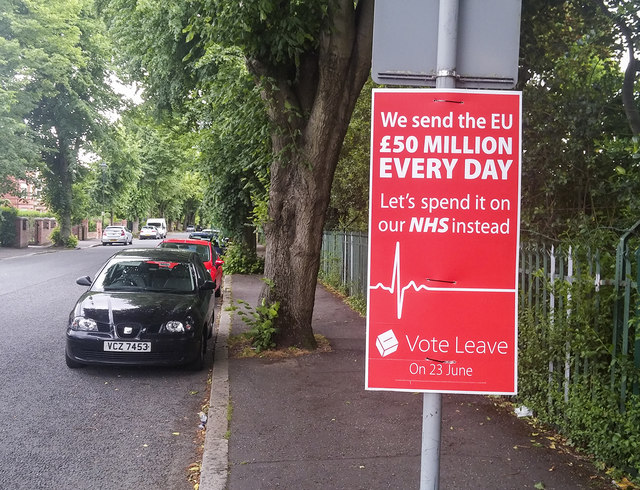
Following a renegotiation of membership terms, Cameron announced the referendum for 23 June 2016. The Leave campaign's central claim — "£350 million a week for the NHS" — directly connected EU membership to the austerity of public services. It was factually misleading (the figure ignored the UK's rebate) but politically lethal: it told communities whose hospitals, libraries, and schools had been cut that EU budget contributions were the cause.

The Mediterranean refugee crisis imagery was woven into the campaign. Nigel Farage unveiled a poster showing a long line of migrants with the caption "Breaking Point." The poster deliberately conflated Syrian refugees (not EU citizens, not using freedom of movement) with EU freedom of movement. The strategy was to activate the residual fear from 2015 and redirect it toward EU membership.

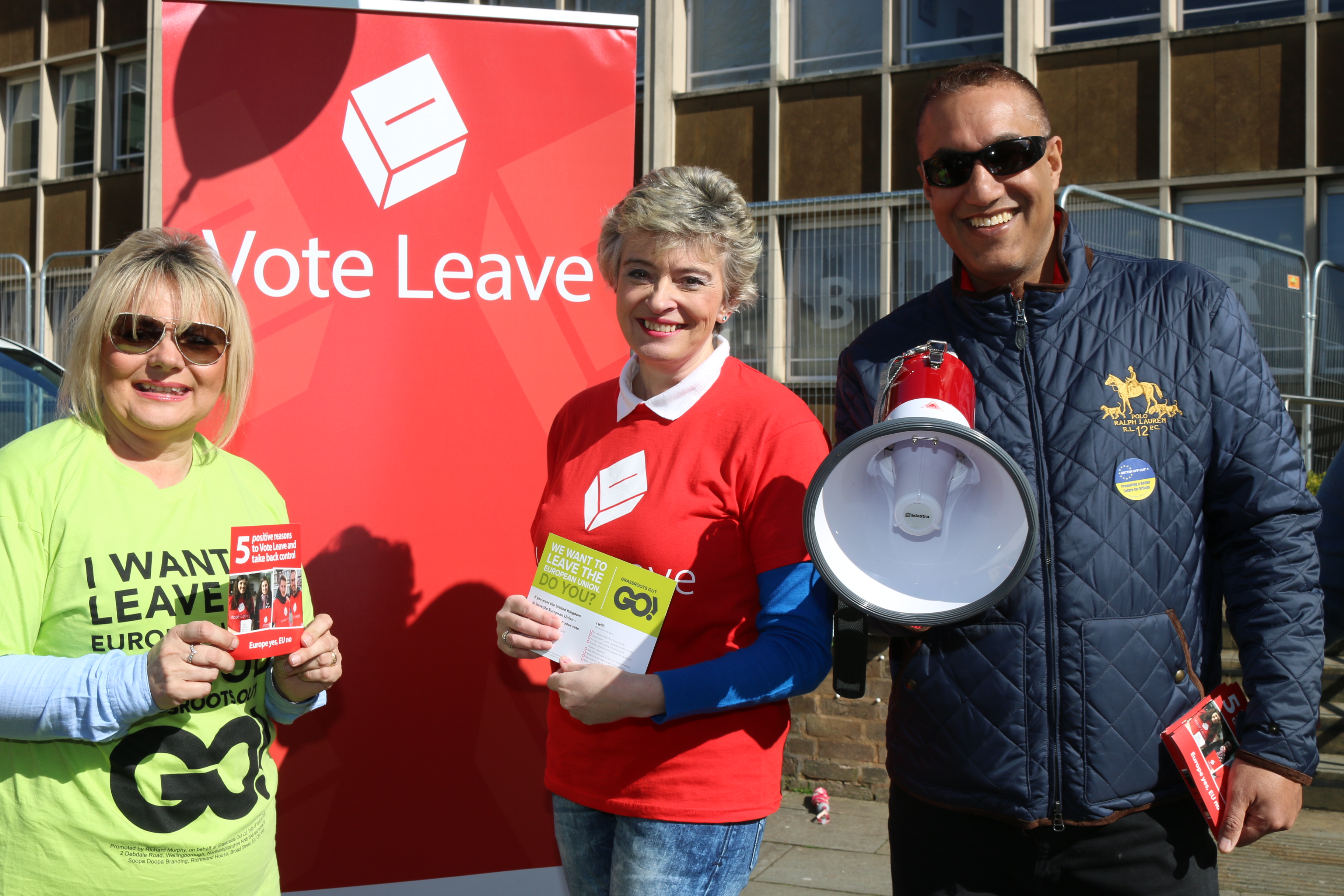
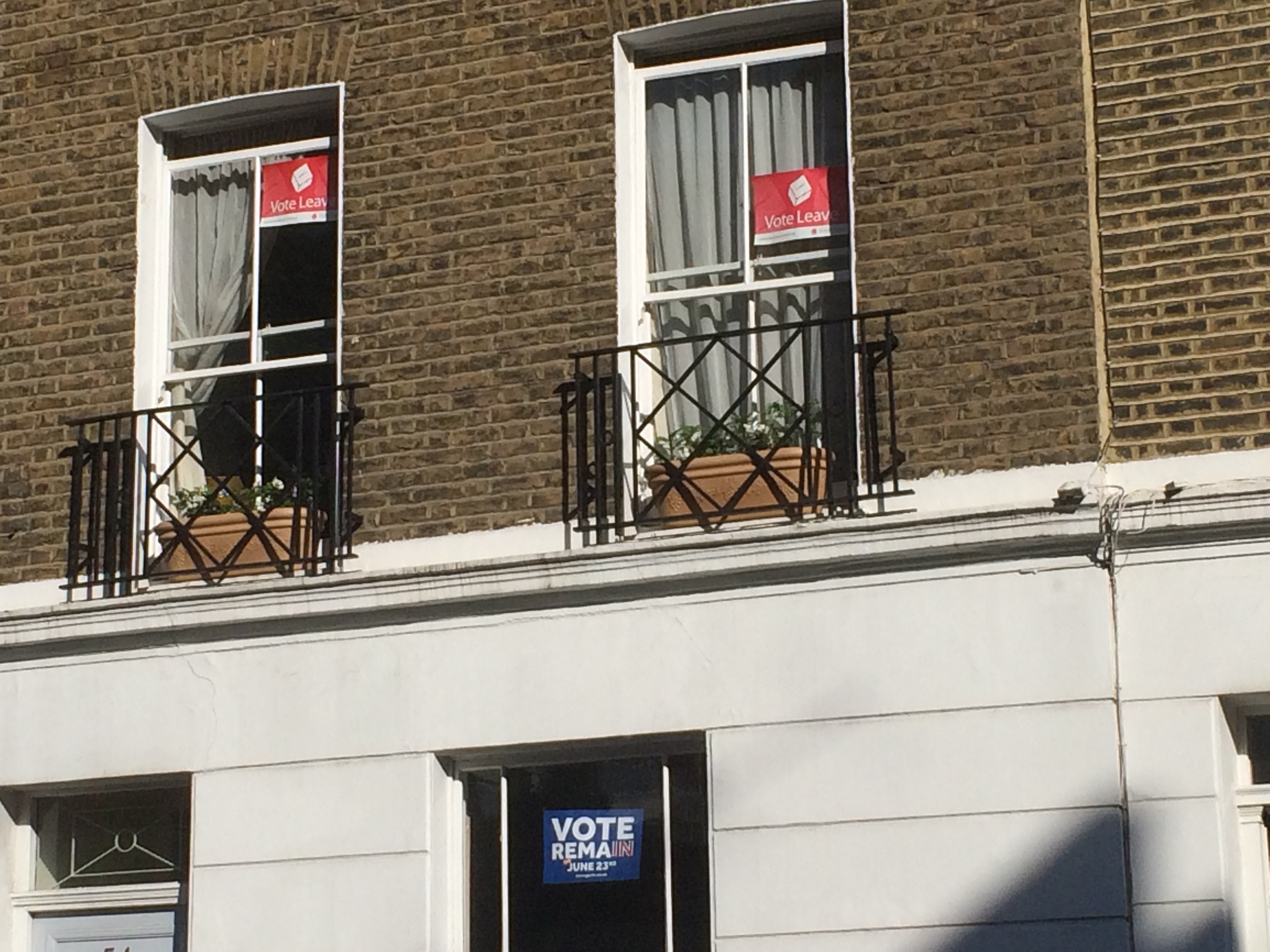
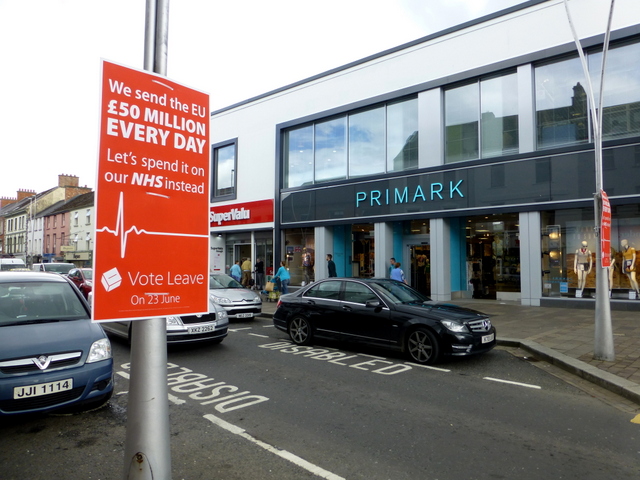
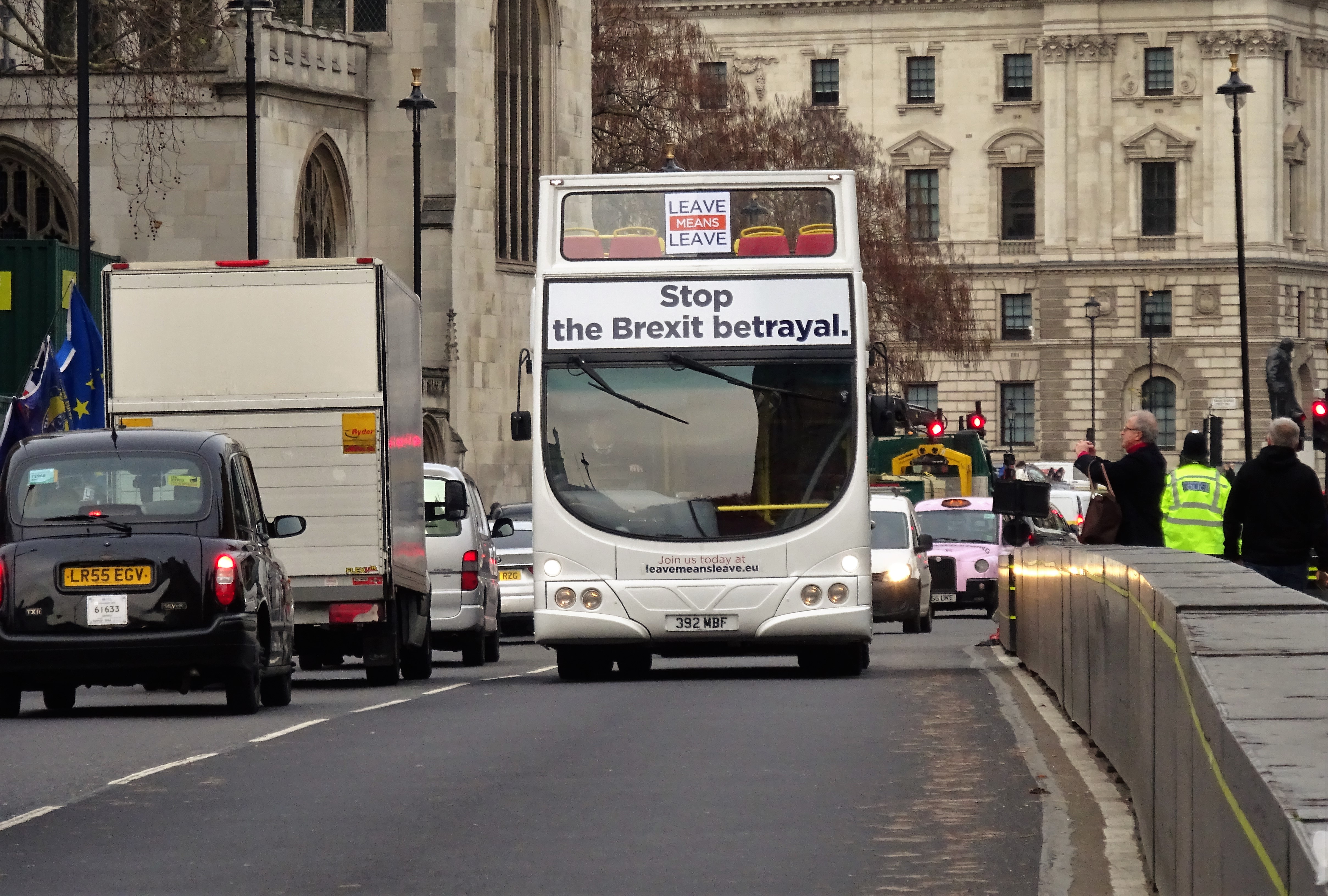
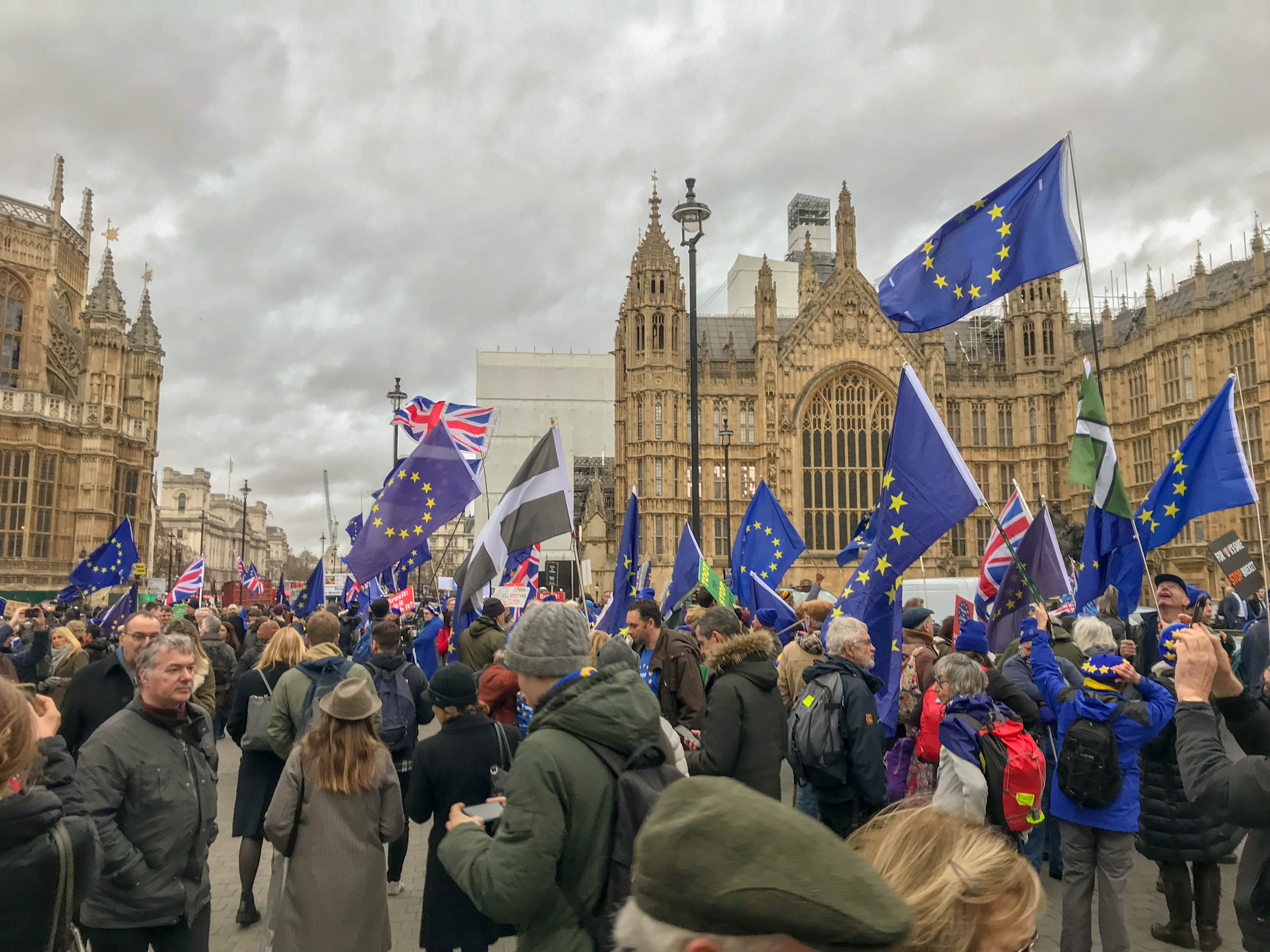
The campaign images on the right show this fusion in practice: Vote Leave posters linking immigration directly to NHS funding, ground-level canvassing in austerity-hit areas, and the Leave/Remain juxtaposition on the same street.

The Referendum Campaign: NHS, Sovereignty, Immigration

The Vote Leave campaign linked EU membership directly to NHS underfunding — the £350m/week claim. It fused two grievances that austerity had created: underfunded public services and visible social change.

Vote Leave NHS poster 2016

Vote Leave poster prominently featuring the NHS claim — the strategy of linking EU budget contributions to NHS underfunding
Wikimedia Commons
Vote Leave campaign group in Warwick, May 2016

Vote Leave campaign group in Warwick, May 2016 — ground-level mobilisation in a market town with high austerity exposure
Wikimedia Commons
Leave and Remain posters side by side in Pimlico, June 2016

Leave and Remain campaign posters side by side, Pimlico, London — June 2016
Wikimedia Commons
Vote Leave poster in Omagh

Vote Leave poster in Omagh, Northern Ireland — the campaign reached every corner of the UK
Wikimedia Commons
Facebook ad archive layer

One campaign,many Brexits

The referendum campaign did not only connect austerity and immigration. On Facebook, it also turned Brexit into a variable policy object. Different voters could be shown different implied Brexits: less regulation, more protection, lower bills, more hospitals, global openness, or border panic.

The exhibit below uses real ad creatives released through the UK Parliament/DCMS inquiry, coupled with metadata on the advertisements: was Brexit actually needed to do what the ad implied?

BeLeave ride-home regulation ad Vote Leave animal welfare ad Vote Leave Turkey/Syria border ad Vote Leave NHS hospital ad
Tension 1

Control as deregulation — or control as stronger prohibition?

The same master slogan, take back control, points in opposite policy directions. In one version, control means removing EU rules from everyday life. In another, control means using sovereign power to impose tougher moral protections.

Less regulation

“The EU should not be regulating your ride home.”
deregulation “The EU should not be regulating your ride home.” BrexitCentral/BeLeave, creative 2880. Spreadsheet theme: EU controls regulations; take back control of regulations.
“Get EU regulators out of the way.”
market freedom “Get EU regulators out of the way.” BrexitCentral/BeLeave, creative 2882. Prosperity is framed as removing external regulators.
VS

More protection

“Control of our animals and their welfare?”
protective regulation “Control of our animals and their welfare?” Vote Leave, creative 2951. The text says EU law blocks a UK ban on live transport of livestock for slaughter.
“This is not okay. Stop animal abuse.”
moral enforcement “This is not okay. Stop animal abuse.” Vote Leave, creative 2971. EU payments are linked to bullfighting and animal cruelty.
Tension 2

Free-market Brexit — or worker-protection Brexit?

A second contradiction is ideological. One ad family promises a brighter, competitive Britain once EU regulators and protectionism are removed. Another says the EU acts for big business against workers, and asks people to vote Leave to protect worker rights.

The policy platform is elastic: pro-business competitiveness for one audience; anti-big-business labour protection for another.

Market liberalism

“Trade deals create jobs. But the EU won’t let us make them.”
global markets “Trade deals create jobs. But the EU won’t let us make them.” BeLeave, creative 2888. The spreadsheet frames EU protectionism as blocking key trade deals.
“We just need to get EU regulators out of the way.”
anti-regulation “We just need to get EU regulators out of the way.” BeLeave, creative 2882. A competitive future is framed as deregulation.
VS

Worker protection

“The EU acts in the interests of big business.”
anti-corporate “The EU acts in the interests of big business.” Vote Leave, creative 3042. Campaign text: the EU acts against workers.
“The EU puts pressure on unions and workers rights.”
labour rights “The EU puts pressure on unions and workers rights.” Vote Leave, creative 3043. The call-to-action is “Protect Worker Rights!”
Tension 3

Global openness — or border panic?

The campaign could sound cosmopolitan: a fair immigration system, talent from all over the globe, non-discrimination, new trade deals. But another stream used maps, arrows, Syria, Iraq and Turkey to turn EU membership into a border emergency.

The same “control” frame can mean openness to global skills or closure against a fantasised frontier threat.

Open global Britain

“A fair immigration system that doesn’t discriminate.”
global talent “A fair immigration system that doesn’t discriminate.” BeLeave, creative 2887. Campaign text: bring in talent from all over the globe.
“Welcomes people with the skills we need.”
skills system “Welcomes people with the skills we need.” DUP Vote to Leave, creative 2903. Better borders are framed as skills selection.
VS

Border threat

“Turkey has a 511 mile border with Syria.”
phantom emergency “Turkey has a 511 mile border with Syria.” Vote Leave, creative 3046. Turkey accession is made visually proximate to the UK.